







What's Happening?
A Metro Nashville police officer, Joshua Baney, a 12-year veteran of the force, has been decommissioned and relieved of all police authority following his fatal shooting of 54-year-old Jason William Sexton. The incident occurred on Cheshire Drive around
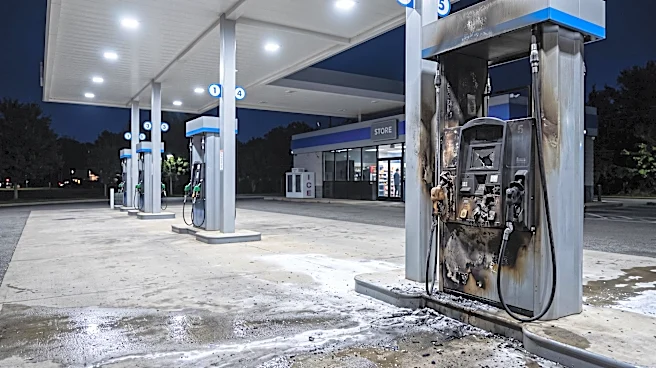
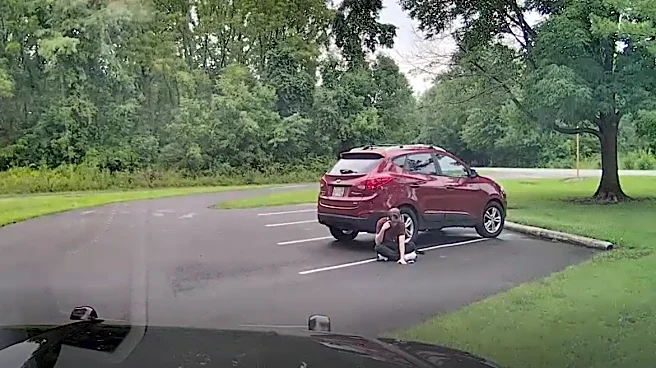
11:25 a.m. on a Saturday. Police had been attempting to apprehend Sexton since the previous Friday on outstanding warrants, including order of protection violations and criminal trespassing. The situation escalated when Sexton, armed with a 'full-size sword,' reportedly threatened a Shell gas station clerk earlier that morning, yelling, 'Come outside now, I’ll kill you.' A felony aggravated assault warrant was subsequently issued. A relative of Sexton also called 911, expressing concerns about his danger to others and his possession of a sword, citing recent Instagram videos. A police helicopter tracked Sexton's vehicle to Cheshire Drive, where ground units converged. Sexton exited his car, still armed with the sword, and began yelling at officers. A 26-year-old woman was found in the back seat of Sexton's car, reportedly being held against her will. Officers attempted to de-escalate the situation for over an hour before SWAT arrived. Officer Baney, initially directed to block Sexton's vehicle, fired three shots at Sexton, who was holding the sword. Sexton was transported to the hospital, where he succumbed to his injuries. The woman in the car was unharmed.
Why It's Important?
This incident highlights critical issues surrounding police use of force, particularly in situations involving individuals armed with non-firearm weapons and potential mental health concerns. The immediate decommissioning of Officer Baney and the dual investigations by the Tennessee Bureau of Investigation (TBI) and the Metro Nashville Police Department (MNPD) underscore the seriousness with which such events are treated. The presence of outstanding warrants, a prior threat with a weapon, and the alleged kidnapping of a woman complicate the narrative, placing officers in a high-stakes scenario. The release of bodycam footage is crucial for transparency and public accountability, allowing for a detailed review of the events leading to the fatal shooting. This case will likely contribute to ongoing national discussions about police training for de-escalation, engagement with individuals exhibiting erratic behavior, and the protocols for handling situations where suspects are armed with bladed weapons. The outcome of the investigations could influence future police policies and training mandates, aiming to balance officer safety with minimizing lethal force.
What's Next?
The Tennessee Bureau of Investigation (TBI) is currently leading the investigation into the shooting, which is standard procedure for officer-involved shootings in the state. Concurrently, the Metro Nashville Police Department (MNPD) is conducting its own separate administrative investigation. Officer Joshua Baney remains decommissioned and relieved of all police authority during these investigations. The bodycam footage released by the MNPD will be a key piece of evidence for both inquiries, providing a visual record of the confrontation. The TBI's findings will be presented to the District Attorney General, who will then determine if any criminal charges against Officer Baney are warranted. The MNPD's administrative review will assess whether department policies and procedures were followed. Depending on the outcomes, there could be further legal proceedings, internal disciplinary actions, or potential changes to MNPD's training and engagement protocols for similar incidents. Public reaction and advocacy groups will likely monitor these investigations closely, potentially influencing the discourse around police accountability and reform.
Beyond the Headlines
This event delves into the complex intersection of law enforcement, mental health, and public safety. The report of Sexton's relative calling 911 due to concerns about his behavior and his display of a sword on Instagram suggests a potential underlying mental health crisis, which often complicates police encounters. The challenge for law enforcement lies in distinguishing between criminal intent and a mental health episode, and responding appropriately to each. The presence of a sword, while not a firearm, still poses a significant threat, especially in close quarters, forcing officers to make rapid, life-or-death decisions. This incident may reignite debates about the resources available to police for mental health interventions and whether alternative response models, involving mental health professionals, could be more effective in de-escalating such situations without resorting to lethal force. The alleged kidnapping further complicates the ethical and tactical considerations, as officers must prioritize the safety of potential victims while managing a volatile suspect. The case underscores the need for comprehensive approaches that address both law enforcement training and community-based mental health support.