
What's Happening?
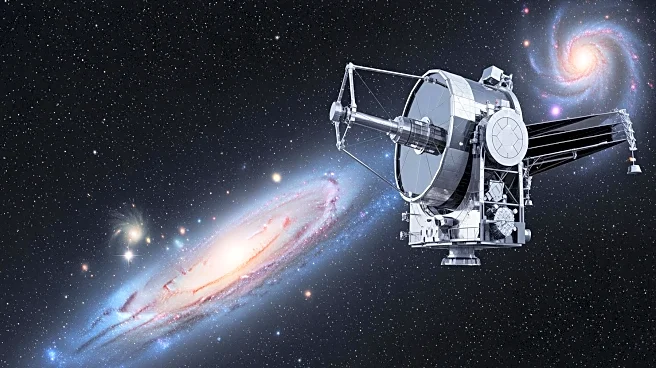
Astronomers have identified a new Earth-sized planet, HD 137010 b, orbiting a sun-like star approximately 146 light-years from Earth. This discovery was made using data from NASA's Kepler space telescope's
K2 mission, analyzed by an international team led by University of Southern Queensland researcher Alexander Venner. The planet is about six percent larger than Earth and has a 355-day orbit. Researchers estimate a 50 percent chance that it resides in the habitable zone of its star, although its surface temperature may be similar to Mars, potentially below -94°F (-70°C). The findings were published in The Astrophysical Journal Letters.
Why It's Important?
The discovery of HD 137010 b is significant as it adds to the growing list of exoplanets that could potentially support life. The planet's proximity to the habitable zone raises the possibility of liquid water, a key ingredient for life as we know it. This finding could influence future astronomical research and exploration, as scientists seek to understand the conditions that allow planets to support life. The study also highlights the continued utility of data from the Kepler mission, which, despite its conclusion in 2018, continues to yield important discoveries.
What's Next?
Further observations are needed to confirm the exact nature of HD 137010 b and its potential to support life. Researchers will likely focus on studying the planet's atmosphere and surface conditions to determine its habitability. The planet's relatively close proximity to Earth makes it a prime candidate for follow-up investigations using more advanced telescopes and observational techniques. These efforts could provide deeper insights into the characteristics of exoplanets and the potential for life beyond our solar system.