What's Happening?
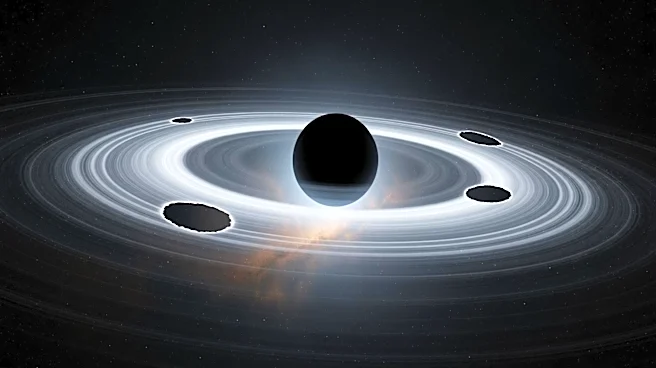
The James Webb Space Telescope (JWST) has made a groundbreaking discovery by identifying a black hole that appears to have formed before its host galaxy, a finding that challenges existing scientific theories
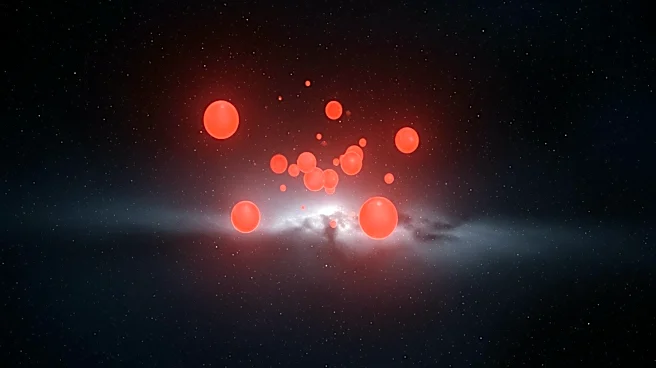
about black hole formation. This discovery was made while observing ancient galaxies known as 'Little Red Dots,' which were first identified in 2022. These galaxies are prevalent in the early universe but seem to vanish around 1.5 billion years after the Big Bang. The JWST has also detected numerous supermassive black holes with masses millions to billions of times that of the sun, existing less than a billion years after the Big Bang. This is significant because it was previously believed that black holes required more time to grow to such sizes. The study focused on a specific Little Red Dot, Abell2744-QSO1, which existed 700 million years after the Big Bang. The research suggests that these black holes might have formed directly, without the need for a massive star to collapse first, indicating that they could predate the galaxies that eventually host them.
Why It's Important?
This discovery has profound implications for our understanding of black hole formation and the early universe. It suggests that the processes leading to the creation of supermassive black holes might be more complex and varied than previously thought. If black holes can form before their host galaxies, it could mean that the conditions in the early universe were conducive to rapid black hole formation, potentially altering our understanding of cosmic evolution. This finding could lead to a reevaluation of the timeline and mechanisms of galaxy formation, impacting theories in astrophysics and cosmology. The research also highlights the capabilities of the JWST in providing new insights into the universe's infancy, which could drive further scientific inquiry and exploration.
What's Next?
The research team plans to continue studying other Little Red Dots to determine if they also contain supermassive black holes with galaxies forming around them. This ongoing research could provide further evidence to support or refute the current findings, potentially leading to new models of black hole and galaxy formation. The scientific community may also explore alternative theories to explain these observations, possibly involving new physics or unknown processes from the early universe. As more data is collected, it could lead to a deeper understanding of the universe's formative years and the role of black holes in cosmic evolution.
Beyond the Headlines
The discovery raises questions about the fundamental nature of black holes and their role in the universe. It challenges the traditional view that black holes form from the remnants of massive stars, suggesting instead that they might originate from different processes. This could have implications for the study of dark matter and energy, as well as the overall structure of the universe. Additionally, the findings may influence the search for extraterrestrial life, as the conditions around early black holes could affect the habitability of surrounding regions. The research underscores the importance of advanced telescopes like the JWST in expanding our understanding of the cosmos.