





What's Happening?
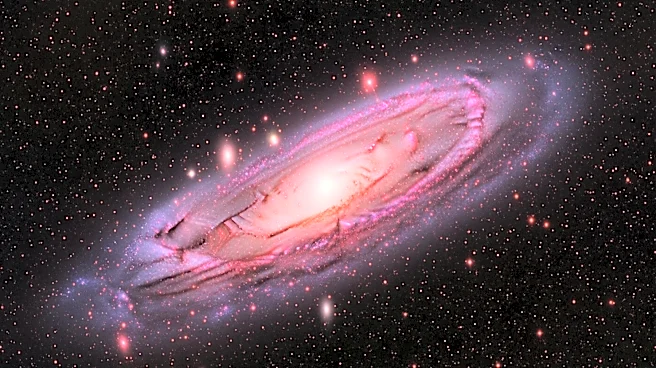
NASA's Hubble Space Telescope has captured a detailed image of the barred spiral galaxy IC 486, located about 380 million light-years from Earth in the constellation Gemini. The image reveals the galaxy's bright central bar-shaped structure and spiral arms,
with variations in color indicating regions of older and newer star formations. The galaxy's active galactic nucleus, powered by a supermassive black hole, emits intense radiation that outshines the surrounding starlight. The data for this image was collected from two observing programs aimed at surveying nearby active galaxies and studying their central black holes and stars.
Why It's Important?
The detailed imaging of IC 486 provides valuable insights into the dynamics of galaxy formation and evolution. Understanding the interaction between stars, gas, dust, and black holes in galaxy centers can help scientists learn how galaxies grow and evolve over time. The study of active galactic nuclei, like the one in IC 486, is crucial for understanding the role of supermassive black holes in galaxy dynamics. This research also contributes to the development of machine learning techniques for classifying galaxy morphology, which can be applied to large-scale surveys conducted by future telescopes.