


What's Happening?
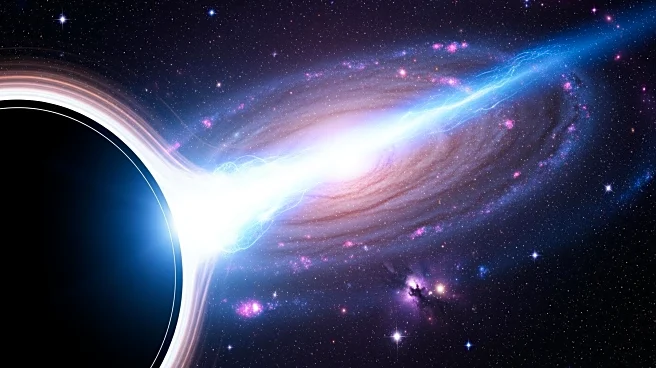
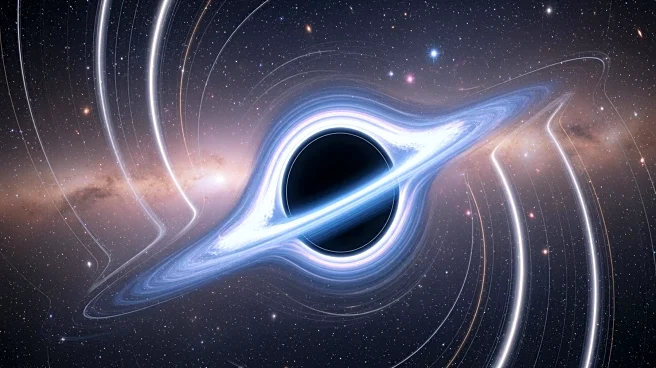
Researchers have observed a black hole twisting spacetime, a phenomenon known as Lense-Thirring precession or frame-dragging, for the first time. This was observed in a tidal disruption event (TDE) where a star was torn apart by a supermassive black hole,
forming a spinning disk and launching jets of material. The study, led by the National Astronomical Observatories at the Chinese Academy of Sciences with Cardiff University, tracked a 20-day cycle of wobbling in X-ray and radio signals. This supports a key prediction of general relativity, first proposed by Einstein and mathematically formulated by Lense and Thirring.
Why It's Important?
This observation provides compelling evidence of frame-dragging, a fundamental aspect of general relativity, and offers new insights into black hole physics. Understanding how black holes influence their surroundings can help scientists explore the mechanics of accretion disks and jet formation. This discovery also opens new avenues for studying the spin and gravitational effects of black holes, potentially leading to breakthroughs in astrophysics and our understanding of the universe.
What's Next?
Researchers will likely continue to study similar tidal disruption events to gather more data on frame-dragging and its implications. Further observations using advanced telescopes could refine our understanding of black hole dynamics and their role in cosmic evolution. This research may also inspire new theoretical models to explain the complex interactions between black holes and their environments.