



What's Happening?
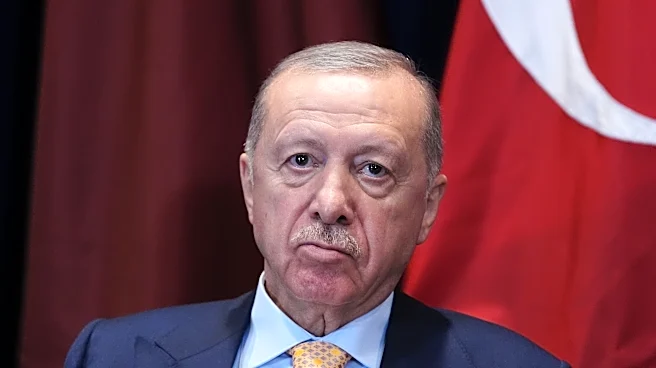
Turkey, a long-standing NATO member and EU candidate, is actively engaging with multiple, often conflicting, international orders, including the China- and Russia-led Shanghai Cooperation Organisation. This approach, described as 'forum shopping' by President
Recep Tayyip Erdoğan, aims to expand Turkey's freedom of action and reduce external constraints. For instance, Turkey has militarily supported the internationally recognized government in Libya while criticizing NATO allies like France for backing opponents. Concurrently, it has maintained 'competitive co-existence' with Russia, which supported the opposing faction in Libya, moderating rhetoric and avoiding direct clashes. In the African Sahel, Turkey has boosted trade, aid, and defense cooperation, including drone sales, capitalizing on regional resentment towards France's military presence. This strategy is seen as an effort to recast international politics, positioning Turkey as a power capable of shaping the global system rather than being defined by any single alliance.
Why It's Important?
Turkey's foreign policy strategy of engaging with diverse international orders has significant implications for global power dynamics and the stability of existing alliances. By pursuing relationships with both Western and non-Western blocs, Turkey challenges the traditional post-Cold War vision of a single global order centered on Western institutions. This 'forum shopping' approach could inspire other middle powers to assert greater autonomy, potentially leading to a more fragmented and complex international landscape. For the U.S. and its NATO allies, Turkey's actions introduce an element of unpredictability, as its alignment on specific issues may shift based on its perceived national interests rather than strict alliance loyalty. This could complicate coordinated international responses to crises and necessitate a re-evaluation of diplomatic and strategic engagements with countries that adopt similar multi-alignment strategies. The long-term impact could be a weakening of traditional alliance structures and the emergence of a more fluid, multi-polar world order.
What's Next?
Turkey is expected to continue its strategy of engaging with various international institutions and coalitions to maximize its influence and minimize external limitations. This will likely involve further deepening economic, political, and strategic relationships with non-Western powers while maintaining its embeddedness within NATO and economic ties to Europe. The country's ambition to expand its freedom of action may lead to continued friction and mistrust with some traditional allies, particularly when its interests diverge. Future developments could include Turkey seeking to broker more international agreements, similar to its role in the Black Sea grain agreement, leveraging its unique position between different blocs. However, its room for maneuver is constrained by its economic dependence on European markets and Western finance, and its security reliance on NATO. The balance between asserting autonomy and managing these dependencies will be a continuous challenge for Turkey's foreign policy.
Beyond the Headlines
Turkey's 'populist world-making' approach, as described in the source, extends its domestic populist strategy onto the international stage, portraying Turkey as a nation denied its rightful status by Western-dominated hierarchies. This narrative resonates with a broader global trend where emerging powers seek to challenge established international norms and institutions. The ethical and cultural dimensions of this strategy involve a redefinition of national identity and sovereignty in a globalized world, where countries are increasingly unwilling to be confined by historical alliances or ideological blocs. This shift could lead to a more pragmatic and transactional international relations environment, where alliances are formed and dissolved based on immediate interests rather than long-term ideological alignment. The long-term implication is a potential erosion of multilateralism based on shared values, replaced by a more flexible, interest-driven plurilateralism that could reshape global governance and international cooperation.