



What's Happening?
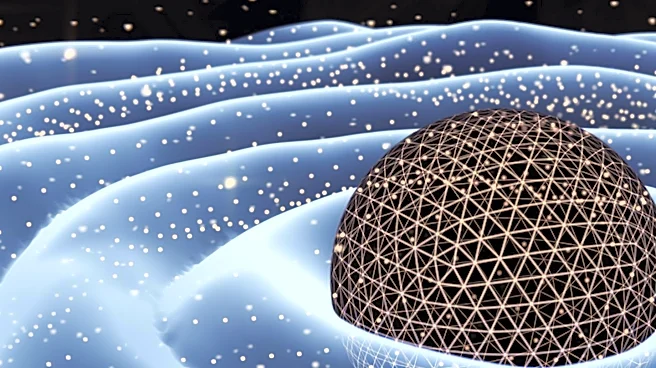
A new study by Sohan Ghodla and Cosmin Ilie of Colgate University suggests that the mysterious background of extremely low-frequency gravitational waves detected by pulsar timing arrays (PTAs) may carry information about events from over 13 billion years
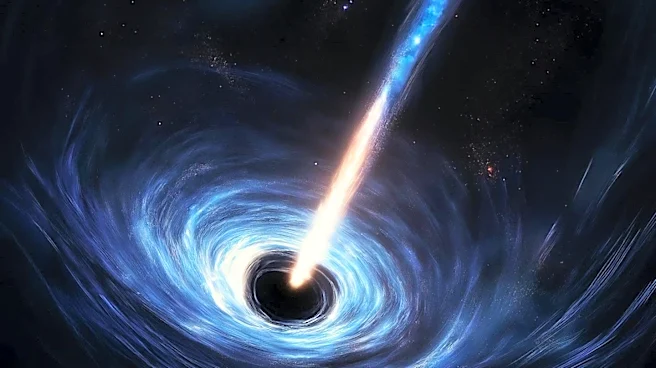
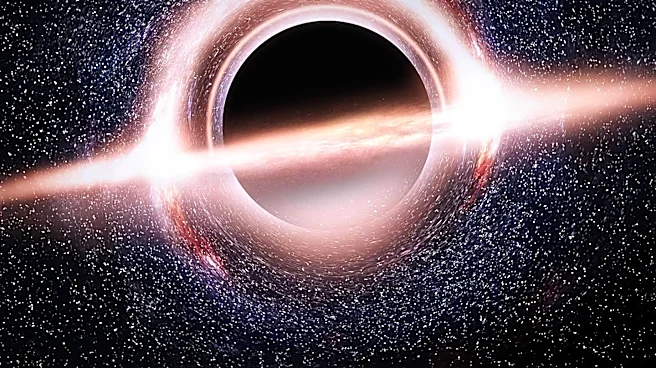
ago, specifically the formation of some of the universe's first supermassive black holes. The research, published in Physical Review D, investigates whether supermassive black holes formed in the early universe could contribute significantly to the observed gravitational-wave background. Their findings indicate a direct connection between observations of unexpectedly massive black holes in the young universe and gravitational waves produced by supermassive black-hole binaries billions of years later. Notably, the study proposes that black holes originating from the collapse of supermassive Dark Stars—a hypothetical type of primordial star powered by dark matter—could account for a dominant portion of the PTA signal.
Why It's Important?
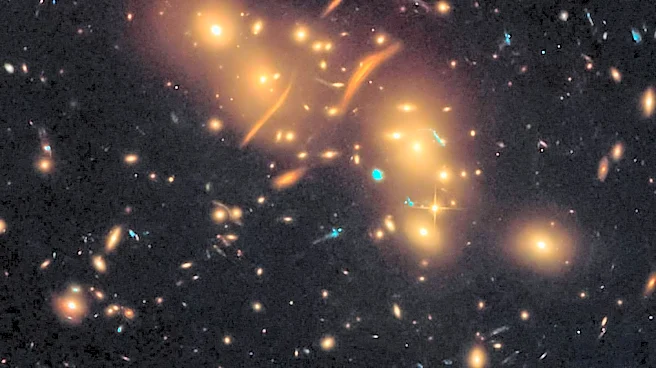
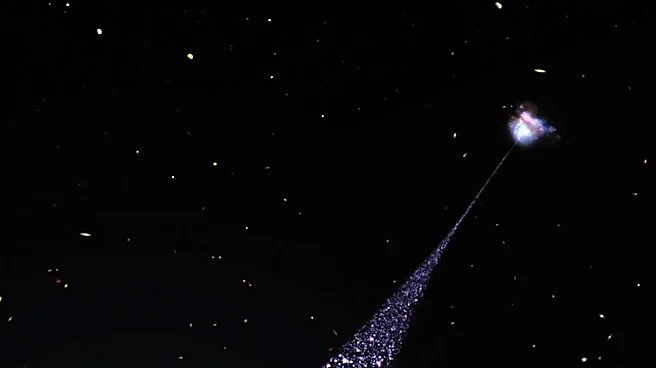
This study offers a novel perspective on the origin of the gravitational-wave background and its implications for understanding the early universe. PTAs, which use rapidly rotating neutron stars as precise cosmic clocks, have detected a stochastic gravitational-wave background, primarily attributed to inspiraling supermassive black-hole binaries in the relatively recent universe. However, the Colgate University research suggests that this signal could also contain crucial information about how the ancestors of these black holes formed at 'cosmic dawn.' By linking the observed gravitational waves to the remnants of supermassive Dark Stars, the study provides a potential mechanism for the rapid formation of massive black-hole seeds observed surprisingly early in cosmic history by facilities like the James Webb Space Telescope. This connection could help resolve the puzzle of how such enormous black holes came into existence so quickly after the Big Bang.
What's Next?
The research indicates that future improvements in PTA measurements, combined with better constraints on high-redshift black-hole populations and their host galaxies, could help distinguish among different scenarios for the origin of the universe's first supermassive black holes. The study also establishes that existing PTA measurements can be used to place an upper limit on the abundance of early supermassive black hole seeds. Producing too many of these massive seeds would overproduce the PTA-detected signal, while too few would necessitate other sources to efficiently assemble supermassive black holes later in the universe's life to match observations. This means PTA observations could unexpectedly constrain populations of objects that existed at redshifts greater than 10, even if their gravitational-wave-producing mergers occurred much later. This opens a new observational window into the birth of the first supermassive black holes and the role of dark matter in their formation.
Beyond the Headlines
The concept of Dark Stars as progenitors for supermassive black holes introduces a fascinating interplay between dark matter physics and the evolution of the early universe. Dark Stars, powered by dark matter heating rather than nuclear fusion, could grow to immense sizes before collapsing into massive black holes. This study suggests that the gravitational-wave 'echoes' detected today could be a direct imprint of these primordial objects, offering a unique way to test their possible role in cosmic history. This work bridges seemingly disparate fields—gravitational-wave astronomy, cosmology, and particle physics (through dark matter)—to provide a more holistic understanding of cosmic evolution. It highlights how subtle signals from the present can unlock profound secrets about the universe's distant past, potentially revealing the mechanisms that seeded the supermassive black holes found at the centers of most galaxies today.