




What's Happening?
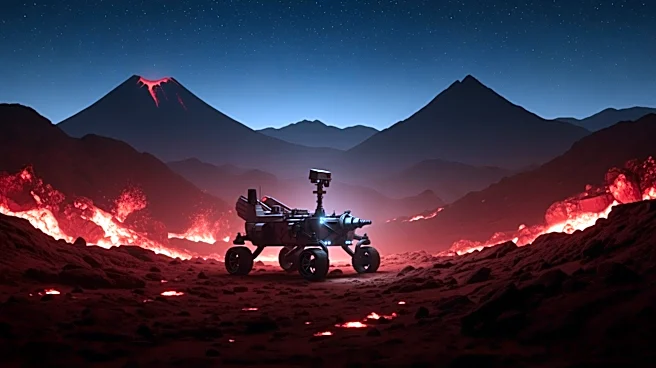
The SETI Institute has introduced the Orpheus mission, a vertical takeoff and landing (VTOL) hopper designed to explore Mars' volcanic regions in search of life. Presented at the 57th Lunar and Planetary Science Conference, the mission aims to investigate
deep volcanic fissures and caves, which are some of the youngest and most active areas on Mars. Unlike traditional rovers, Orpheus will use a VTOL system to navigate these challenging terrains, allowing it to access steep volcanic craters and deep pits that are otherwise inaccessible. Equipped with scientific instruments such as a color camera, a near-infrared spectrometer, and ground-penetrating radar, Orpheus will analyze soil and rock compositions, search for biosignatures, and study the geology of these regions. The mission will focus on the Cerberus Fossae region, known for its recent volcanic activity, which scientists believe could harbor conditions suitable for life.
Why It's Important?
The Orpheus mission represents a significant advancement in the search for extraterrestrial life, particularly on Mars. By targeting volcanic regions, the mission seeks to explore areas that may offer shelter from the harsh surface conditions of Mars, such as radiation and toxic chemicals. These regions, similar to Earth's volcanic vents, could provide the necessary heat, water, and chemical nutrients to support life. Discovering life on Mars would have profound implications for our understanding of life in the universe and could influence future space exploration strategies. The mission's innovative approach using VTOL technology also sets a precedent for exploring difficult terrains on other planets, potentially expanding the scope of scientific research beyond traditional rover capabilities.
What's Next?
The Orpheus mission is still in the proposal stage, with further development and testing required before it can be launched. Researchers will continue to refine the mission's objectives and technology, ensuring that the VTOL system and scientific instruments are capable of performing the necessary tasks on Mars. Collaboration with space agencies and securing funding will be crucial for advancing the mission. If successful, Orpheus could pave the way for future missions to explore other challenging environments on Mars and beyond, potentially leading to groundbreaking discoveries about the planet's geological history and the possibility of life.
Beyond the Headlines
The exploration of Mars' volcanic regions by Orpheus could also provide insights into the planet's geological processes and history. Understanding these processes may reveal how Mars evolved over time and whether it ever had conditions similar to Earth. Additionally, the mission could contribute to the study of planetary habitability, offering clues about the potential for life on other planets with similar volcanic activity. The ethical considerations of searching for life on Mars also come into play, as scientists must ensure that missions do not contaminate potential habitats with Earth-based organisms.