





What's Happening?
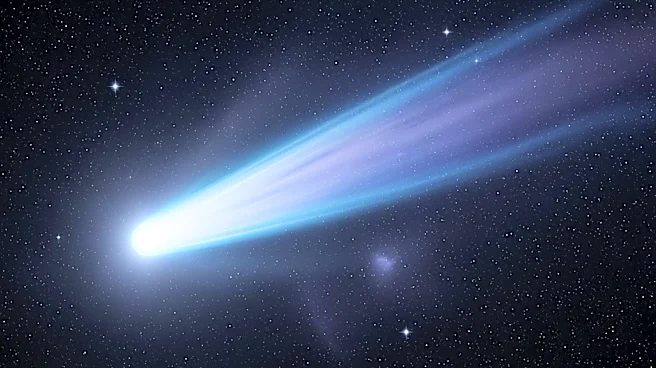
Astronomers have identified the interstellar comet 3I/ATLAS in images taken by the Vera C. Rubin Observatory before its official discovery on July 1, 2025. The comet was captured during the observatory's science validation phase, revealing its presence
ten days prior to its recognition by the Asteroid Terrestrial-impact Last Alert System (ATLAS). The early observations, published in The Astrophysical Journal Letters, show the comet's active state as it approached the sun, providing a unique opportunity to study an interstellar object. The Rubin Observatory's ability to detect such comets highlights its potential for future discoveries.
Why It's Important?
The early detection of 3I/ATLAS underscores the capabilities of the Vera C. Rubin Observatory in identifying interstellar objects, which are crucial for understanding the composition and origins of bodies from outside our solar system. The comet's analysis offers insights into the environments where such objects form, as its chemical composition differs from typical solar system comets. This discovery enhances our understanding of interstellar visitors and their potential impact on our solar system, contributing to the broader field of astronomy and the study of cosmic phenomena.
What's Next?
Future observations of 3I/ATLAS and similar interstellar comets will be facilitated by upcoming missions and advanced telescopes. The Rubin Observatory's Legacy Survey of Space and Time mission aims to detect more interstellar objects, potentially one per year. Continued study of 3I/ATLAS will help refine models of interstellar comet behavior and composition, guiding predictions of future visitors and enhancing our understanding of the universe's diversity.