
What's Happening?
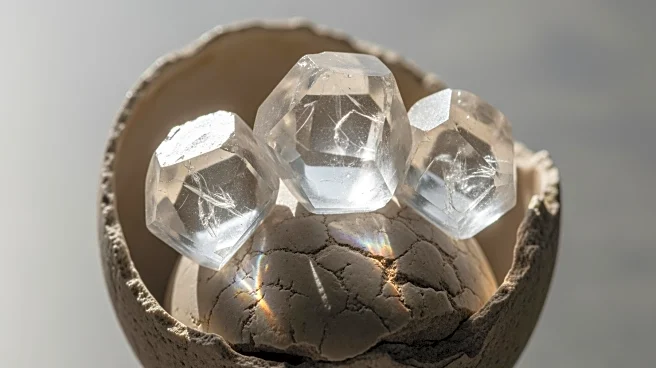
A 70-million-year-old dinosaur egg discovered in the Chishan Formation in China has revealed calcite crystals inside, leading to the identification of a new oospecies, Shixingoolithus qianshanensis. The
egg, found in the Qianshan Basin, was transformed into a natural geode due to mineralization processes that occurred after burial. This rare preservation offers new insights into the microstructure and fossilization processes of the Late Cretaceous period. The discovery expands the scientific understanding of the environmental conditions and faunal diversity of the region during that era. The calcite crystals, not part of the egg's original structure, provide valuable data on the geochemical environment and the processes that occurred post-burial.
Why It's Important?
This discovery is significant as it provides a unique opportunity to study the fossilization process and the environmental conditions of the Late Cretaceous period. The identification of a new oospecies adds to the paleontological record and enhances the understanding of dinosaur diversity and distribution. The presence of calcite crystals offers a novel method for dating fossils and studying the geochemical history of fossil sites. This could lead to new techniques in paleontology, allowing for more precise reconstructions of ancient ecosystems and the conditions that led to the preservation of fossils.
What's Next?
Future research will likely focus on further analyzing the calcite crystals and the microstructure of the egg to gain deeper insights into the fossilization process. Scientists may also explore other fossil sites for similar mineralization patterns, potentially uncovering more about the environmental conditions of the time. The findings could inspire new methodologies in paleontological research, particularly in the study of fossilized eggs and their preservation. Additionally, the discovery may prompt a reevaluation of the Chishan Formation's paleontological significance, encouraging more extensive excavations and studies in the region.