
What's Happening?
Researchers have identified a new species of fish, Charon’s pygmygoby (Trimma charon), in the northern Red Sea. This small, translucent fish, measuring between 12 and 17 millimeters, features a distinctive
broad orange-red stripe, golden spots on its tail, and an unusual four-part eye. The discovery was made at the entrance to a cave on a steep reef slope. Only two specimens of Charon’s pygmygoby have been found to date, suggesting it may primarily inhabit deeper, unexplored 'mesophotic' reefs below 30 meters. The species is named after Charon from Greek mythology, alluding to the golden spots on its tail resembling coins and its potential dwelling in the 'underworld' of deep reefs. The study, led by Viktor Nunes Peinemann at King Abdullah University of Science and Technology (KAUST), Saudi Arabia, and co-authored by Matthew D. Tietbohl Talas, Michael L. Berumen, and Sergey V. Bogorodsky, was published in the journal ZooKeys. This finding brings the total number of Trimma species known in the Red Sea to 11, with at least nine believed to be endemic to the region.
Why It's Important?
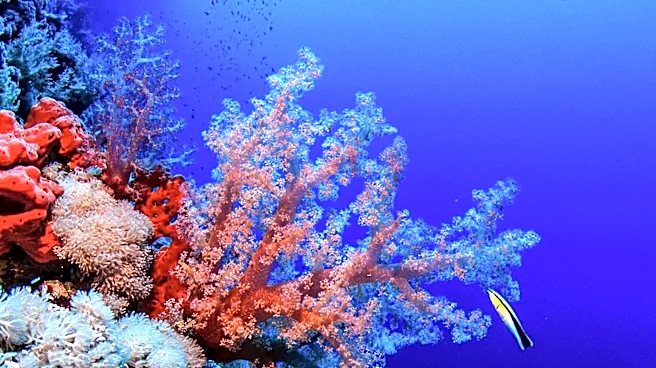
The discovery of Charon’s pygmygoby underscores the significant biodiversity that remains unexplored in the Red Sea's deep reef ecosystems. These 'mesophotic' reefs, often overlooked due to their depth, may harbor numerous undiscovered species, making them crucial areas for marine conservation and scientific research. Understanding the presence, identification, and habitat of these species is a foundational step toward building a stronger comprehension of marine ecosystems. The unique characteristics of the new species, such as its four-part eye and golden spots, could offer insights into evolutionary adaptations to deep-sea environments. Furthermore, the finding highlights the importance of continued exploration and study of deep-sea habitats, which are increasingly vulnerable to environmental changes and human impact. The Red Sea's high endemism for Trimma species suggests it is a critical hotspot for goby evolution, emphasizing the need for targeted conservation efforts in the region.
What's Next?
Future research will likely focus on further exploration of the Red Sea's mesophotic reefs to locate more specimens of Charon’s pygmygoby and other potential new species. The research team suggests that deeper reefs almost certainly contain more undiscovered gobies, indicating a need for advanced deep-sea exploration techniques. Genetic comparisons with similar species, such as the pallid pygmygoby (Trimma anaima), will be crucial to confirm evolutionary relationships and understand the speciation processes in the region. The illustrated identification key provided in the study for all 11 Red Sea Trimma species will aid future marine biologists and conservationists in identifying and monitoring these hard-to-spot fishes. Continued efforts to map and understand these deep-sea environments will be essential for developing effective conservation strategies to protect their unique biodiversity.
Beyond the Headlines
The naming of Charon’s pygmygoby, inspired by Greek mythology, adds a cultural dimension to scientific discovery, connecting ancient narratives with modern exploration. This practice can help engage a broader public in the importance of biodiversity and marine science. The challenges faced in finding more specimens of this fish, despite extensive searches, highlight the inherent difficulties and resource intensity of deep-sea research. It also points to the possibility that many species may exist in extremely limited populations or in highly specific, hard-to-reach niches, making them particularly vulnerable to extinction before they are even fully understood. The focus on 'mesophotic' reefs brings attention to an often-neglected depth zone, bridging the gap between shallow, well-studied coral reefs and the abyssal plains, and emphasizing the continuous nature of marine ecosystems.