






What's Happening?
The American labor movement's historical trajectory, particularly its peak after World War II when one in three workers was unionized, is being re-examined in the context of current organizing challenges. Vivek Chibber highlights several factors that
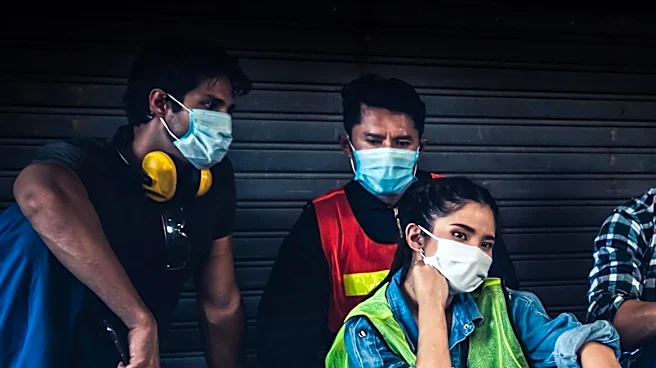
facilitated unionization in the past, including larger workplaces that allowed for economies of scale in organizing, and a close connection between workplaces and communities where social and class ties overlapped. Additionally, the lack of political rights for many workers in earlier eras fostered a stronger class identity, as oppression extended beyond the workplace into daily life. In contrast, modern capitalism presents a fragmented workplace environment with smaller venues, a separation of work from home, and intense work rhythms that limit worker interaction. These changes, coupled with slower economic growth since the 1980s, have increased employer resistance to unions, making contemporary organizing efforts significantly more difficult.
Why It's Important?
This analysis is crucial for understanding the current state and future potential of the U.S. labor movement. The historical context reveals that the conditions that once favored strong unionization—such as large, centralized workplaces and cohesive working-class communities—have largely eroded. This shift impacts the strategies and effectiveness of modern labor organizing, requiring new approaches to address fragmented workforces and increased employer opposition. For U.S. industries, a weakened labor movement can lead to stagnant wages and reduced worker protections, potentially affecting consumer spending and economic inequality. For politics, the decline in union power can diminish a significant voice for working-class interests, influencing policy debates on labor laws, social welfare, and economic regulation. The discussion underscores the need for innovative strategies to rebuild labor power in a changed economic and social landscape, potentially involving greater state intervention to foster economic growth and support unionization.
What's Next?
The ongoing discussion suggests that the labor movement must adapt its strategies to the realities of modern capitalism. This includes identifying new vulnerabilities within the current system and developing organizing tactics that can overcome fragmented workplaces and increased employer resistance. Future efforts may involve a greater focus on digital organizing, community-based initiatives that bridge the gap between work and home life, and advocacy for policy changes that support workers' rights and collective bargaining. There is also an implicit call for socialists and labor activists to collaborate more closely, leveraging their respective strengths to build a more robust movement. The role of the state in fostering economic growth and supporting unionization is highlighted as a critical precondition for the resurgence of labor power. Without such adaptations, the challenges faced by unions in the U.S. are likely to persist, potentially leading to continued struggles for workers' rights and economic equity.
Beyond the Headlines
The deeper implications of the labor movement's evolution touch upon fundamental questions of power, identity, and social cohesion in the U.S. The historical account reveals how shared experiences of oppression and close-knit communities once forged a strong working-class identity, which is now largely absent due to suburbanization and atomized workplaces. This fragmentation not only hinders unionization but also contributes to a broader decline in collective action and civic engagement. Ethically, the discussion raises concerns about the inherent power imbalance between employers and individual workers, particularly in a slow-growth economy where job security is precarious. The argument that employers who cannot pay living wages 'shouldn’t exist' challenges the prevailing capitalist ethos and suggests a moral imperative for economic systems to prioritize human dignity over profit. Culturally, the shift from a shared working-class culture to one where capitalists and workers share the 'same culture' through mass media points to the erosion of distinct class consciousness, making it harder to mobilize workers around common interests.