
What's Happening?
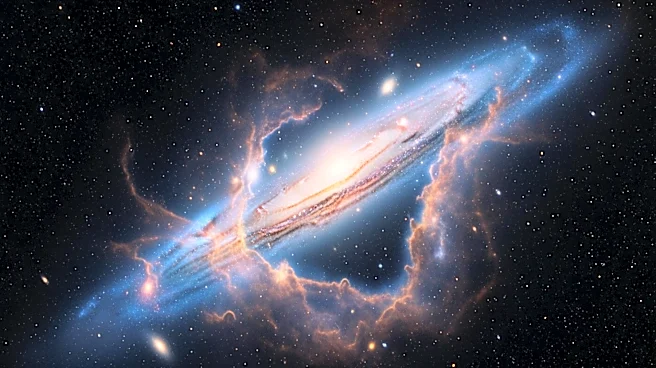
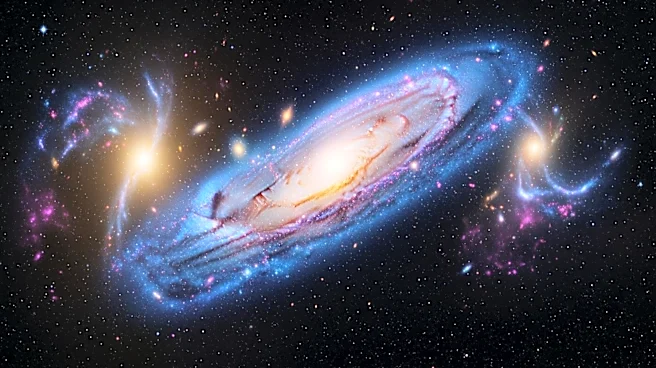
Astronomers using the James Webb Space Telescope (JWST) have discovered a fully formed stellar bar in a massive galaxy from the early universe, a structure previously thought impossible according to current
models. This galaxy, known as GN20, existed when the universe was only a tenth of its current age. The bar acts as a gravitational conveyor belt, channeling gas and dust towards the galactic center, triggering intense star formation and potentially fueling a supermassive black hole. This discovery challenges existing theories about galaxy formation and the rapid growth of black holes shortly after the Big Bang.
Why It's Important?
The discovery of a stellar bar in GN20 provides new insights into the mechanisms of galaxy evolution and black hole formation in the early universe. It suggests that turbulent, bar-driven systems may play a crucial role in the rapid growth of supermassive black holes, a phenomenon that has puzzled astronomers. This finding could lead to revisions in theoretical models of galaxy formation, emphasizing the role of turbulence in stabilizing structures that were previously thought to be impossible. The implications extend to understanding the lifecycle of galaxies and the conditions that lead to their 'death' or cessation of star formation.
What's Next?
Further research will focus on resolving the kinematics within GN20's bar to better understand the role of turbulence in its formation. Observations using instruments like ALMA may provide detailed insights into the gas velocity field, supporting or refuting the turbulent-stabilization hypothesis. Theoretical models will need to incorporate these findings, potentially leading to significant revisions in our understanding of early galaxy dynamics. This discovery opens new avenues for exploring the complex processes that shaped the universe's earliest structures.