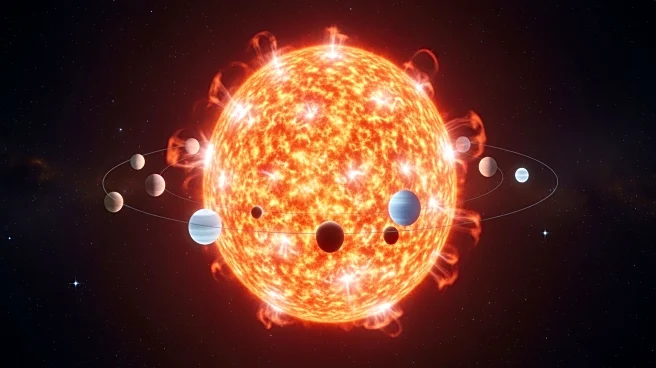




What's Happening?
Researchers are using data from the James Webb Space Telescope (JWST) to study the TRAPPIST-1 star system, located about 40 light-years away in the constellation Aquarius. This ultracool red dwarf star hosts seven Earth-sized planets, three of which are in the 'habitable
zone' where liquid water might exist. However, the star is highly active, emitting energy bursts approximately six times a day, which can threaten the atmospheres of these planets. By analyzing six flares observed in 2022 and 2023, scientists are attempting to understand the impact of these flares on the planets' atmospheres. The study suggests that while the innermost planets may have lost their atmospheres, one planet, TRAPPIST-1e, might still retain a thin, Earth-like atmosphere, potentially supporting life.
Why It's Important?
The study of TRAPPIST-1's flares is crucial for understanding the potential habitability of its planets. The findings could refine predictions about which planetary atmospheres might survive the star's frequent outbursts. This research is significant for the broader search for life beyond Earth, as it provides insights into how stellar activity affects planetary environments. The ability to identify planets that might support life has implications for future space exploration and the search for extraterrestrial life, potentially guiding future missions to these distant worlds.