
What's Happening?
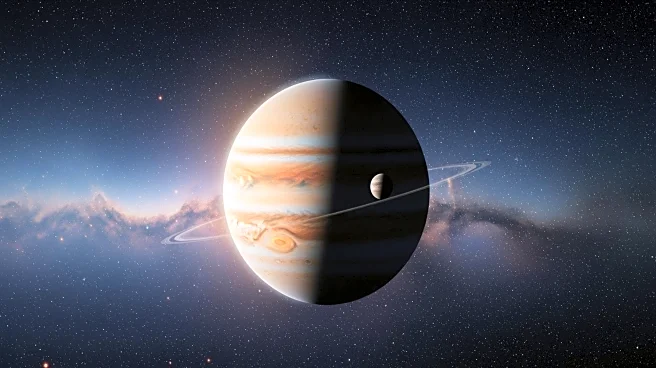
Chinese scientists have confirmed the existence of a free-floating planet with a mass comparable to Saturn. This celestial body, which does not orbit any star, was identified through a process known as microlensing.
The research, led by a team from Peking University's Department of Astronomy, marks the first successful direct mass measurement of such a planet. The findings were published in the journal Science, with team leader Dong Subo explaining that these objects are detected when their gravity bends the light of a background star, causing a temporary brightening.
Why It's Important?
This discovery is significant as it enhances our understanding of planetary formation and the dynamics of celestial bodies that do not conform to traditional planetary systems. Free-floating planets like this one challenge existing models of planetary formation, which typically involve a star. The ability to measure the mass of such a planet directly provides valuable data that could lead to new insights into the processes that govern the universe. This advancement in astronomical techniques could pave the way for further discoveries of similar rogue planets, potentially altering our understanding of the cosmos.