


What's Happening?
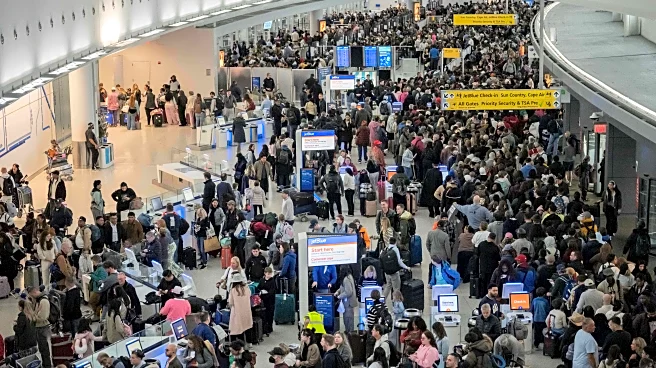
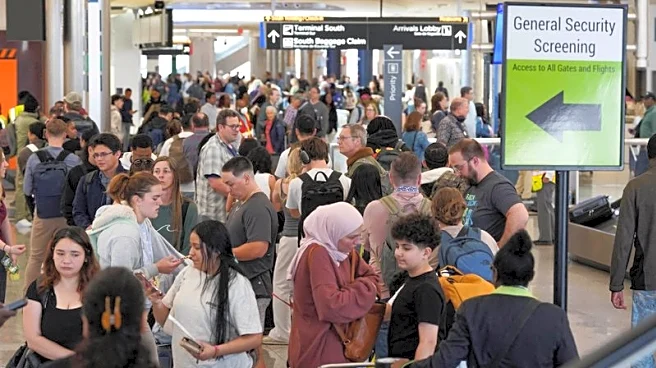
President Trump has ordered Immigration and Customs Enforcement (ICE) agents to be deployed at major airports across the United States to address long security lines caused by a partial government shutdown. The Transportation Security Administration (TSA)
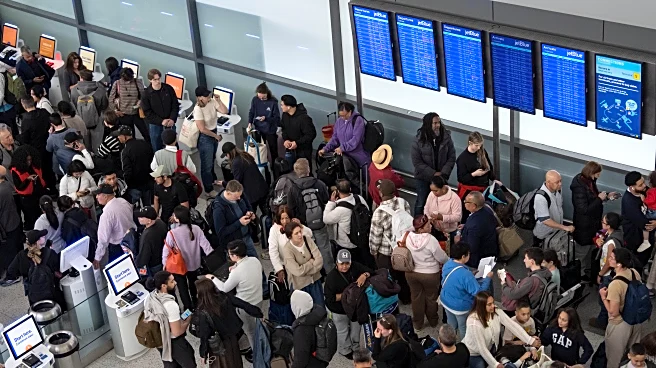
has been experiencing significant staffing shortages, with over 400 officers quitting due to working without regular pay. ICE agents have been spotted at several airports, including Hartsfield-Jackson Atlanta International Airport and John F. Kennedy International Airport. The deployment aims to assist TSA by freeing up agents from certain duties, although ICE agents are not trained to operate X-ray machines. Instead, they are expected to handle support roles such as guarding exits and managing non-screening tasks. The presence of ICE agents has sparked mixed reactions, with some travelers noting no significant improvement in wait times.
Why It's Important?
The deployment of ICE agents to airports highlights the ongoing challenges faced by the TSA due to the government shutdown. This move underscores the critical need for adequate staffing and funding for essential services like airport security. The decision to use ICE agents, who are still receiving regular pay, contrasts with the unpaid status of TSA officers, raising questions about funding priorities within the Department of Homeland Security. The situation also brings attention to the broader implications of government shutdowns on public services and the potential impact on travelers' experiences. Civil rights groups have expressed concerns about the possibility of targeted immigration enforcement, although ICE's stated role is to support TSA operations rather than conduct immigration checks.
What's Next?
As the government shutdown continues, the effectiveness of ICE agents in alleviating TSA staffing shortages will be closely monitored. The situation may prompt further discussions on funding allocations and the need for a resolution to the shutdown to restore normal operations. Stakeholders, including political leaders and civil rights organizations, may push for clarity on the role of ICE agents at airports and advocate for measures to ensure that immigration enforcement does not interfere with airport security operations. The ongoing situation could also influence future policy decisions regarding the management of essential services during government shutdowns.