
What's Happening?
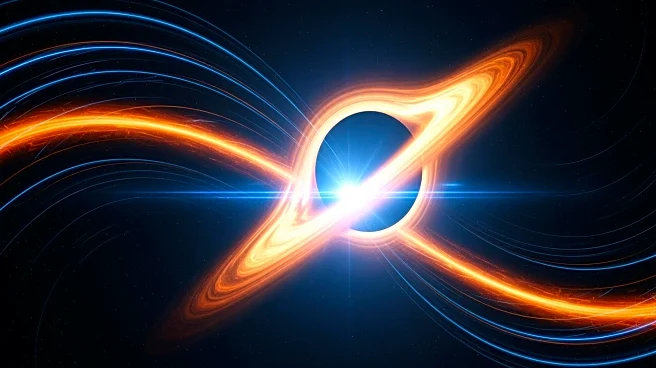
Astronomers using the XMM-Newton and XRISM observatories have documented a rare event involving a supermassive black hole in the galaxy NGC 3783. This black hole, located approximately 130 million light-years
from Earth, emitted a sudden X-ray flare that quickly diminished, followed by the emergence of ultra-fast winds. These winds, moving at about one-fifth the speed of light, were observed for the first time forming in just a single day. The event was captured in real-time, providing new insights into the behavior of black holes and their influence on surrounding environments. The black hole, with a mass of about 30 million Suns, is part of an Active Galactic Nucleus (AGN), a highly energetic region that emits light across the electromagnetic spectrum.
Why It's Important?
This discovery is significant as it provides a deeper understanding of the dynamics within AGNs and the role of magnetic fields in generating such powerful winds. The findings suggest that the processes occurring in supermassive black holes can be analogous to solar phenomena, such as coronal mass ejections, but on a much larger scale. This could have implications for understanding the evolution of galaxies and the formation of stars, as AGNs are known to influence their host galaxies significantly. The research highlights the importance of international collaboration in space exploration, as the event was observed using instruments from ESA, JAXA, and NASA.
What's Next?
Future observations and studies will likely focus on further understanding the mechanisms behind these ultra-fast winds and their impact on galactic environments. Researchers may also explore the potential for similar phenomena in other galaxies, which could provide a broader understanding of the universe's behavior. Continued collaboration between international space agencies will be crucial in advancing this field of study.