





What's Happening?
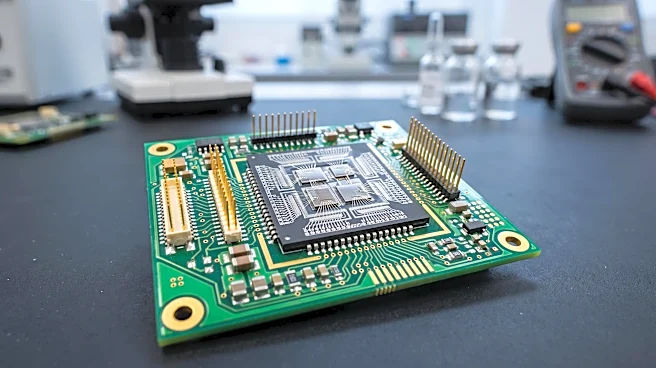
Despite years of sanctions, Russia's newest strike drones, the jet-powered Geran-4 and Geran-5, continue to heavily depend on Western technology, with American manufacturers supplying over 70% of identified foreign components. Examinations of downed drones reveal
components from U.S. companies like Texas Instruments, Analog Devices, Amphenol, and Micron, used in critical systems such as flight computers, navigation, and engine controls. While Russia has increased its use of Chinese components, particularly in older Geran-2 models, and is localizing some engine assembly using Chinese parts, the core electronic components in its advanced drones remain predominantly Western. Some of these components were manufactured as recently as late 2025 and early 2026, indicating Russia's ongoing ability to acquire recent Western electronics.
Why It's Important?
The persistent reliance of Russian advanced weaponry on Western technology, despite extensive sanctions, highlights significant loopholes and challenges in global export control regimes. This situation undermines the effectiveness of sanctions aimed at crippling Russia's military-industrial complex and prolonging its ability to wage war. The continued flow of critical components enables Russia to produce and deploy sophisticated drones, posing an ongoing threat. It also points to complex supply chains involving intermediaries and potentially illicit networks that circumvent restrictions. For Western nations, this necessitates a re-evaluation of sanction enforcement mechanisms, increased scrutiny of dual-use technologies, and greater diplomatic pressure on countries that may be facilitating these transfers, particularly China, which is increasingly involved in supplying electronic assemblies to Russia.
What's Next?
Western governments are expected to intensify efforts to identify and close loopholes in existing sanctions, focusing on tracing supply routes and targeting intermediaries involved in transferring restricted electronics to Russia. There will likely be increased diplomatic pressure on China to cease its involvement in supplying components and electronic assemblies to Russia's military industry. Manufacturers of these components may face greater scrutiny and be required to implement more stringent due diligence to prevent their products from reaching sanctioned entities. Ukraine's allies will continue to share intelligence on component origins to inform these enforcement efforts. The ongoing challenge will be to adapt sanctions and enforcement strategies to keep pace with Russia's evolving procurement methods and supply chain adaptations.
Beyond the Headlines
The continued presence of Western technology in Russian drones raises profound ethical and geopolitical questions about corporate responsibility and the globalized nature of technology. It underscores the difficulty of controlling the end-use of widely available electronic components, many of which have dual civilian and military applications. This situation could lead to calls for more robust international frameworks for technology export control and greater accountability for companies whose products end up in weapons used in conflicts. Furthermore, it highlights the strategic importance of domestic manufacturing capabilities for critical components, as reliance on global supply chains can inadvertently fuel adversaries. The issue also exposes the limitations of sanctions as a standalone tool, emphasizing the need for a comprehensive approach that includes diplomatic, intelligence, and technological countermeasures.