






What's Happening?
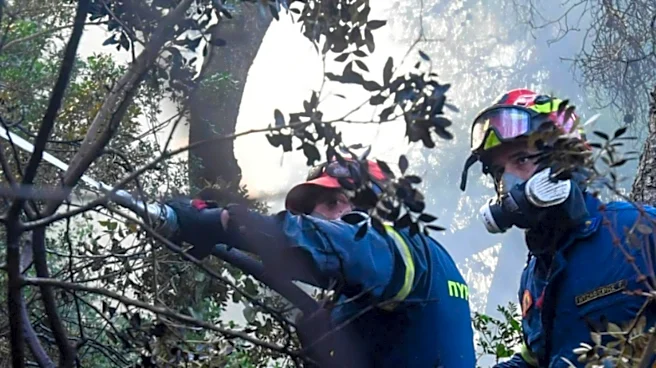
A contributor to the Los Angeles Times argues for a strategic shift in wildfire spending, emphasizing damage prevention over reactive measures. The article highlights that the annual cost of wildfires in the United States is estimated at approximately
$424 billion, encompassing damage to infrastructure, private property, ecosystem services, emergency response, and rehabilitation. While the costs of post-fire damage are well-documented, increasing research demonstrates the significant savings achievable through pre-fire investments. A UC Davis study, for instance, found that every $1 spent on fuel reduction treatments, such as prescribed fire and thinning, saved about $3.75 in wildfire damages across 11 Western states, preventing an estimated $2.8 billion in losses. The article stresses the need to apply this knowledge to guide resource allocation and expand investment in forest health.
Why It's Important?
The current approach to wildfire management, heavily weighted towards post-disaster response, is proving economically unsustainable and environmentally damaging. Shifting investment towards prevention, as advocated, could lead to substantial financial savings for taxpayers, insurance companies, and affected communities. Beyond direct property damage, wildfires incur costs related to human health due to smoke exposure, water quality degradation, and ecosystem services disruption. By investing in forest health and fuel reduction, the U.S. can protect critical infrastructure, reduce healthcare burdens, and safeguard natural resources. This strategic reallocation of funds would benefit a wide array of stakeholders, including healthcare organizations, water utilities, businesses, and public agencies, by mitigating the broader economic and social impacts of wildfires.
What's Next?
The challenge lies in translating research findings into actionable policy and securing the necessary funding for proactive forest management. The article suggests that evidence of avoided damages should guide where resources are allocated, attracting additional investment from diverse partners who benefit from more resilient forests. This includes exploring innovative financing models that involve healthcare organizations, insurance companies, and water utilities. Furthermore, strengthening forest markets for products like engineered wood and biochar could help offset the costs of removing small trees and low-value wood during forest management, supporting rural economies. The ongoing discussion will likely focus on developing a comprehensive portfolio of tools and financial mechanisms to implement effective, long-term wildfire prevention strategies.
Beyond the Headlines
The call to shift wildfire spending from reaction to prevention highlights a fundamental issue in public policy: the difficulty of investing in long-term, less visible solutions over immediate, crisis-driven responses. This perspective also brings to light the interconnectedness of environmental health, public health, and economic stability. Wildfire smoke, for example, affects communities hundreds of miles away, underscoring the regional and national scope of the problem. The article implicitly argues for a redefinition of 'value' in environmental management, where the 'avoided cost' of a disaster is recognized as a tangible economic benefit. This approach could foster greater collaboration between diverse sectors, moving beyond traditional silviculture to a more integrated landscape management strategy that considers the full spectrum of wildfire impacts.