






What's Happening?
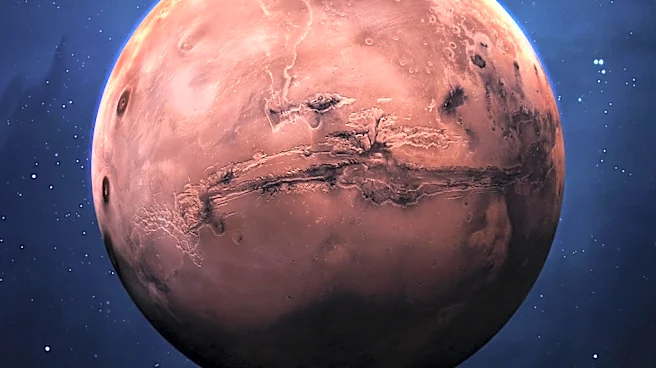
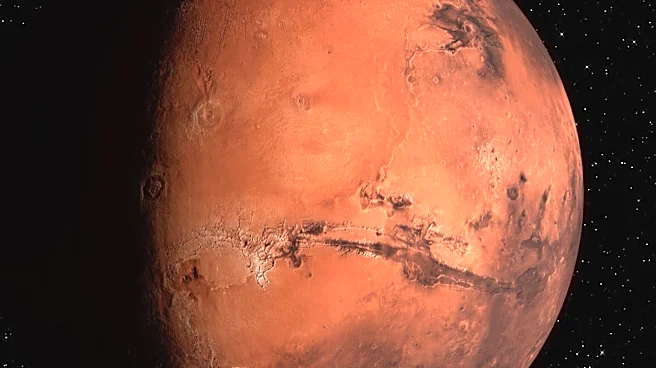
Nineteen-year-old Sophia Karako from Georgia Tech led a group of college students from across the U.S. in a ten-day Mars simulation mission at Titan Ranch in Vilonia, Arkansas. This program, called Southeast Analog, is an analog astronaut program designed
to run realistic human spaceflight missions in Earth locations that resemble the Moon or Mars. The facility, a former Cold War missile silo converted into an Airbnb, served as living quarters for the crew. Participants experienced conditions similar to a Martian mission, including a diet of rehydrated food and a lack of internet access. Mission control for the simulation was based at the Georgia Tech campus in Atlanta, with team members like Shivali Chainani monitoring the mission. The crew also conducted experiments, such as testing a rover's movement on the simulated Martian soil.
Why It's Important?
This Mars simulation is important for advancing human spaceflight research by providing practical experience in conditions mimicking extraterrestrial environments. Such programs help researchers understand the psychological and physiological challenges of long-duration space missions, including the impact of isolation, limited communication, and altered daily schedules. The insights gained from these simulations can inform future mission planning, crew selection, and the development of support systems for actual space travel. By bringing together students from diverse backgrounds, the program also fosters interdisciplinary collaboration and inspires the next generation of space explorers and scientists. The data collected on crew adaptation, communication protocols, and experimental outcomes contributes directly to the U.S. space exploration agenda, potentially reducing risks and increasing the success rate of future manned missions to Mars and beyond.
What's Next?
Following the completion of the Southeast Analog mission, the participating students will return to their respective academic institutions, carrying with them valuable firsthand experience in space simulation. The data and observations collected during the ten-day period, particularly regarding crew dynamics, adaptation to altered schedules (like the Martian 'Sol'), and the performance of experiments, will likely be analyzed by researchers at Georgia Tech and potentially other collaborating institutions. This analysis could lead to published findings that contribute to the broader scientific community's understanding of human factors in space. The students involved, having formed strong bonds and gained unique insights, are expected to continue their studies with a heightened interest in space exploration, potentially pursuing careers in aerospace engineering, planetary science, or related fields. The success of this program may also encourage the development of similar analog missions, further expanding opportunities for practical space research and training.
Beyond the Headlines
The simulation highlights the growing trend of utilizing Earth-based analogs to prepare for complex space missions, offering a cost-effective and safer alternative to actual space travel for initial research and training. The experience of living in isolation, consuming rehydrated food, and adapting to a Martian 'Sol' (24 hours and 40 minutes) underscores the profound psychological and physical adjustments required for long-duration space travel. The students' creation of a 'goop' dictionary for their rehydrated meals, while humorous, reveals a coping mechanism for the monotony and challenges of such an environment, offering insights into crew morale and resilience. This aspect is crucial for understanding the human element of space exploration, which often receives less attention than technological advancements. The program also serves as a powerful educational tool, demystifying space exploration and making it tangible for students, potentially inspiring a new wave of innovation and scientific inquiry in the U.S. space sector.