



What's Happening?
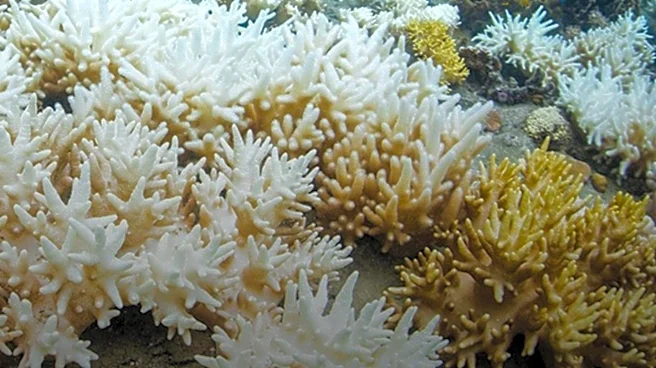
Coral reefs globally are experiencing a significant threat from mass bleaching events, primarily driven by rising ocean temperatures. Scientists indicate that a fifth global bleaching event is likely unfolding, exacerbated by a historically strong El
Niño. This follows four previous global bleaching events since the late 1990s. Coral bleaching occurs when prolonged heat stress causes corals to expel the symbiotic algae living within their tissues, turning them white. Without these algae, which provide much of their energy, corals become vulnerable and can eventually die. Researchers have already found that 44% of coral species worldwide are at risk of extinction, even before the current bleaching event. The Intergovernmental Panel on Climate Change projects that beyond 2 degrees Celsius of warming, 99% of corals would be lost, severely impacting entire ecosystems and the hundreds of millions of people who depend on them for food and livelihoods.
Why It's Important?
The widespread coral bleaching has profound implications for marine biodiversity and human communities. Coral reefs, which cover less than one percent of the ocean floor, are biodiversity hotspots, sheltering approximately a quarter of all marine species. Their degradation threatens the delicate balance of marine ecosystems, potentially leading to cascading effects throughout the food web. Economically, healthy reefs are vital to hundreds of millions of people globally, supporting commercial fishing industries and anchoring tourism economies worth billions of dollars annually. In the U.S., regions like Florida and Pacific territories rely on these reefs for coastal protection from storm surges, a critical function that is diminishing as reefs degrade. The loss of these natural barriers could increase vulnerability to extreme weather events, incurring significant costs for coastal communities and infrastructure.
What's Next?
Conservation groups and coastal communities are actively working to enhance the health of coral reefs to improve their resilience against climate change impacts. These efforts include coral restoration, reducing water pollution, and breeding more heat-tolerant coral varieties. However, the effectiveness of these measures is challenged by the accelerating rate of global warming. International climate negotiations, such as the COP31 summit, are discussing strategies to limit warming, though the original goal of 1.5 degrees Celsius is increasingly seen as unachievable. Future actions will likely focus on mitigating further warming and adapting to the inevitable changes, while also addressing the immediate threats to existing coral populations through targeted conservation and restoration projects.
Beyond the Headlines
The crisis facing coral reefs highlights a broader ethical and environmental dilemma: the balance between economic development and ecological preservation. The potential loss of 99% of corals beyond 2 degrees Celsius of warming underscores the urgency of global climate action and the interconnectedness of Earth's systems. This situation also brings to light the concept of 'tipping points' in natural systems, where incremental changes can lead to irreversible and catastrophic shifts. The degradation of coral reefs is not merely an ecological problem but a cultural and social one, as many indigenous communities and coastal populations have deep historical and economic ties to these ecosystems. The long-term implications include not only biodiversity loss but also potential mass migrations, food insecurity, and increased geopolitical tensions over dwindling marine resources.