



What's Happening?
Kansas City Federal Reserve President Jeff Schmid asserted on Sunday that the U.S. Federal Reserve possesses the necessary tools and responsibility to manage current price pressures, which he described as 'running too hot.' Speaking at a credit union
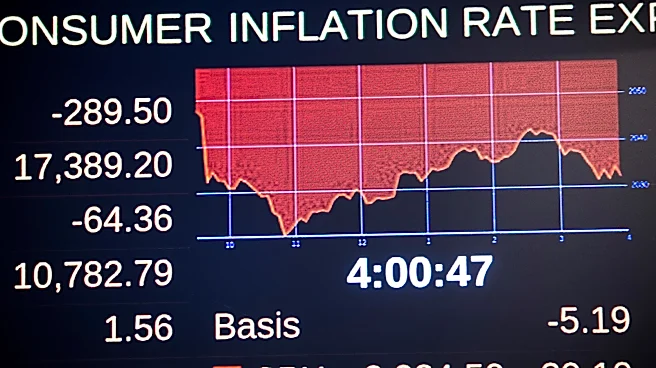
conference in Hawaii, Schmid indicated that the central bank 'has some work to do on inflation.' While he did not explicitly call for additional interest rate hikes, Schmid noted that inflation remains 'uncomfortably above the 2% price stability target' and is 'moving in the wrong direction.' He challenged common narratives suggesting that high inflation is solely due to supply shocks or that demand-induced inflation, such as that from the artificial intelligence buildout, is immune to Fed policy. Schmid emphasized that inflation always results from an imbalance between supply and demand, and the Fed's influence on demand gives it the means to address price stability. The Fed previously raised rates by a quarter-percentage point in September to 3.75%-4.00% but paused at its last meeting. However, following recent higher-than-expected inflation readings and comments from other Fed officials, interest rate futures markets are now pricing in a quarter-point increase at the December meeting, with a slight chance of a half-point hike.
Why It's Important?
Schmid's remarks are significant as they reinforce the Federal Reserve's commitment to its 2% inflation target and push back against the idea that current inflationary pressures are beyond its control. His assertion that demand always plays a role in inflation, even amidst supply disruptions, underscores the Fed's belief in the efficacy of monetary policy tools, particularly interest rate adjustments, to manage economic conditions. This perspective is crucial for market participants and businesses, as it signals that the Fed is prepared to act further if inflation does not show signs of moderating. The debate over whether inflation is primarily supply-driven or demand-driven has substantial implications for policy decisions; if it's demand-driven, higher interest rates are a more direct solution. For consumers, continued efforts to combat inflation could mean higher borrowing costs for mortgages, auto loans, and credit cards, impacting household budgets and spending power. Businesses might face increased costs of capital, potentially affecting investment and expansion plans. The Fed's stance, as articulated by Schmid, suggests a continued hawkish bias until clear progress toward price stability is achieved.
What's Next?
The immediate next step for the Federal Reserve will be its December meeting, where interest rate futures markets are already anticipating a quarter-point hike, with some probability of a half-point increase. This expectation is fueled by recent inflation data exceeding forecasts and hawkish comments from other Fed officials. Should the Fed proceed with another rate hike, it would signal a continued commitment to tightening monetary policy to bring inflation down to its 2% target. Market reactions will be closely watched, as further rate increases could impact stock market performance, bond yields, and the value of the U.S. dollar. Businesses and consumers should prepare for potentially higher borrowing costs. Future inflation reports and employment data will be critical in shaping the Fed's decisions in subsequent meetings. The central bank will likely continue to monitor economic indicators closely, and any signs of persistent inflation or a robust labor market could prompt further tightening measures, while a significant slowdown in economic activity might lead to a pause or even a reversal in policy.
Beyond the Headlines
Schmid's comments highlight a deeper philosophical debate within economic policy circles regarding the nature of modern inflation and the limits of central bank influence. By directly refuting narratives that inflation is either solely supply-driven or impervious to monetary policy due to factors like the AI buildout, Schmid is asserting the traditional view of central bank power and responsibility. This stance has broader implications for how economic shocks are interpreted and addressed. If policymakers believe inflation is largely beyond their control, it could lead to a more passive approach, potentially allowing inflationary pressures to become entrenched. Conversely, an aggressive stance, as advocated by Schmid, risks over-tightening and potentially triggering a recession. The ongoing discussion about the role of artificial intelligence in the economy, and whether its demand-side effects are uniquely resistant to interest rate changes, represents a new frontier in monetary policy challenges. This debate will shape not only immediate interest rate decisions but also the long-term framework for how central banks perceive and manage economic stability in an increasingly technologically driven world.