
What's Happening?
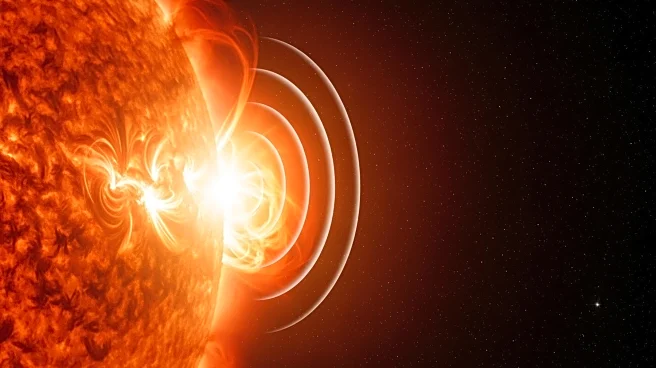
A powerful X1.1-class solar flare erupted from the sun, causing temporary radio blackouts across Australia and parts of Southeast Asia. The flare, originating from sunspot region AR4298, peaked at 12:01
a.m. EST on December 8, 2025. This event was accompanied by a coronal mass ejection (CME), although initial analyses suggest it is not directed towards Earth. The solar flare occurred during a period of heightened solar activity, with several CMEs expected to impact Earth between December 8-9. These events have prompted space weather forecasters to issue geomagnetic storm watches, with potential for strong to moderate storming that could make the northern lights visible at higher latitudes.
Why It's Important?
Solar flares and CMEs can significantly impact Earth's technological systems, particularly affecting radio communications and satellite operations. The recent solar activity highlights the importance of monitoring space weather to mitigate potential disruptions. The ability to predict and prepare for such events is crucial for industries reliant on satellite communications and navigation systems. Additionally, the visibility of auroras at lower latitudes can have cultural and scientific significance, offering opportunities for public engagement with space phenomena.
What's Next?
Space weather forecasters will continue to monitor the sun's activity, particularly as sunspot region AR4298 rotates out of view. The potential impacts of the CMEs expected to reach Earth will be closely observed, with updates provided to relevant stakeholders. The scientific community will analyze data from this event to improve predictive models and enhance understanding of solar dynamics. Public and private sectors reliant on satellite communications will remain vigilant, adjusting operations as necessary to minimize disruptions.