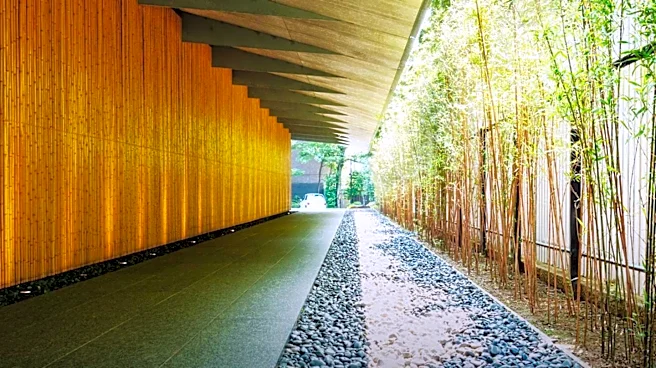







What's Happening?
Jörg Stamm, a German carpenter, has been recognized for his innovative use of bamboo in architecture, particularly in disaster relief efforts in Manabí, Ecuador. Following an earthquake, Stamm collaborated with the local community to construct Casa del
Cacique, a structure that incorporates traditional Ecuadorian house forms using bamboo. This project is part of Stamm's broader work in promoting bamboo as a viable structural material, leveraging geometric principles like hyperbolic paraboloids and hyperboloids to create curved forms without bending the bamboo. His work spans various applications, from jazz stages to family homes, demonstrating bamboo's potential in sustainable architecture.
Why It's Important?
Stamm's work highlights the potential of bamboo as a sustainable building material, especially in regions prone to natural disasters. By using bamboo, which is naturally straight, light, and strong, Stamm's designs offer a cost-effective and environmentally friendly alternative to traditional construction materials. This approach not only aids in disaster recovery but also promotes sustainable development practices. The use of bamboo could significantly impact construction industries, particularly in developing countries, by providing a renewable resource that reduces reliance on more environmentally damaging materials.
What's Next?
Stamm's ongoing projects and collaborations continue to push the boundaries of bamboo architecture. His work with various international organizations and local communities aims to further integrate bamboo into mainstream construction practices. Workshops and publications, such as 'Bamboo Architecture Unboxed,' co-authored with Munir Vahanvati, are part of efforts to educate and inspire architects and engineers worldwide. As awareness grows, bamboo could become a key material in global efforts to combat climate change and promote sustainable urban development.