
What's Happening?
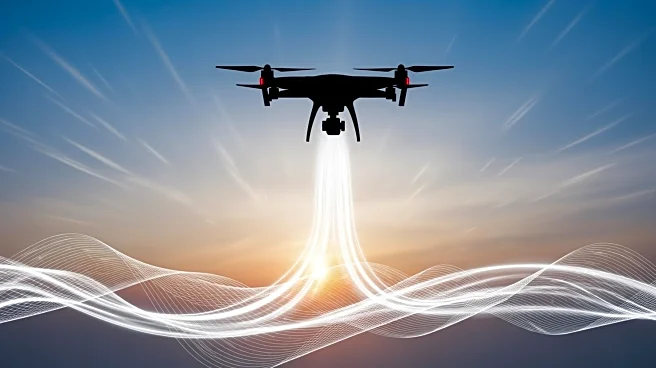
Researchers at Princeton University have developed a micro aerial platform, LaDrone, to explore drone-enabled Lagrangian flow tracking. This approach uses drones as mobile elements within airflow to study
atmospheric dispersion, offering insights into how suspended particles move and disperse. Unlike traditional Eulerian methods, which collect data from fixed locations, Lagrangian techniques follow the motion of individual particles over time. The research aims to enhance the understanding of wind-driven transport and pollution dispersion by using drones to mimic fluid particle behavior.
Why It's Important?
The development of drone-based Lagrangian flow tracking represents a significant advancement in environmental and atmospheric research. This method allows for more flexible and precise data collection, which is crucial for studying complex phenomena such as wildfire smoke propagation, airborne disease transmission, and air quality impacts. By providing a mobile platform for data collection, drones can offer a more detailed and dynamic understanding of atmospheric conditions, potentially leading to better predictive models and more effective environmental policies.