



What's Happening?
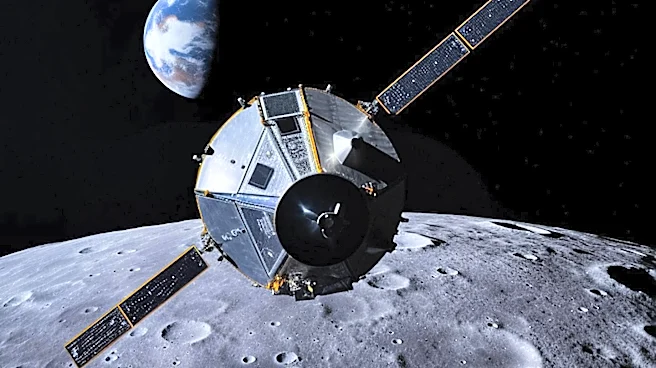
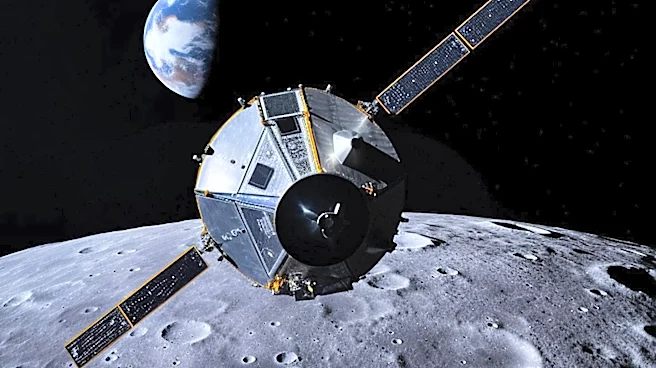
In 1968, the Soviet spacecraft Zond 5 became the first mission to carry living creatures, specifically two Central Asian steppe tortoises, around the Moon and back to Earth. Launched on September 15, 1968, Zond 5 passed approximately 1,950 kilometers
above the lunar far side on September 18, before returning to Earth on September 21. The mission was a precursor to a potential crewed Soviet lunar mission and included a biological experiment with the tortoises, fruit flies, worms, and plants. The tortoises, which were the largest and most recognizable of the biological payload, survived the journey, although they lost about 10% of their body weight due to a pre-launch fasting experiment. The mission demonstrated the feasibility of a circumlunar flight, setting the stage for future human space exploration.
Why It's Important?
The Zond 5 mission was significant as it marked the first time vertebrates traveled around the Moon and returned safely to Earth, showcasing the potential for biological life to endure space travel. This mission was a critical step in the space race, highlighting the Soviet Union's capabilities in space exploration and intensifying the competition with the United States. The success of Zond 5 contributed to the urgency within NASA to accelerate its lunar program, leading to the historic Apollo 8 mission, which became the first human-crewed mission to orbit the Moon. The biological data gathered from Zond 5's mission provided valuable insights into the effects of space travel on living organisms, informing future missions involving human astronauts.
What's Next?
Following the success of Zond 5, the Soviet Union continued to develop its lunar program, although it ultimately did not achieve a crewed lunar landing. The mission's success, however, spurred NASA to expedite its own lunar missions, culminating in the Apollo 8 mission in December 1968, which successfully orbited the Moon with a human crew. The data and experience gained from Zond 5's mission contributed to the broader understanding of space travel's biological impacts, influencing the design and planning of subsequent missions. The competitive context of the space race continued to drive advancements in space technology and exploration strategies.
Beyond the Headlines
The Zond 5 mission underscored the importance of biological experiments in space exploration, highlighting the need to understand the physiological impacts of space travel on living organisms. The choice of tortoises for the mission was strategic, as their ability to survive without food for extended periods made them ideal candidates for the experiment. The mission also demonstrated the challenges of space navigation and recovery, as the spacecraft's return involved a high-load ballistic re-entry and a splashdown in the Indian Ocean, requiring complex recovery operations. These challenges provided valuable lessons for future missions, emphasizing the need for robust systems and contingency planning in space exploration.