


What's Happening?
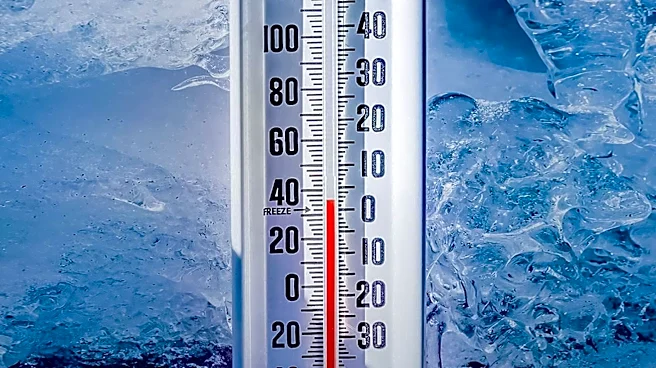
Antarctica's Concordia Station has recorded its coldest temperature in 16 years, reaching minus 119.4 degrees Fahrenheit on July 18. This temperature is the lowest officially reported on Earth since 2012. The extreme cold is attributed to Antarctica's polar
winter, high elevation, and stable weather conditions. Concordia Station, operated by France and Italy, is located on the East Antarctic Plateau, which is known for its harsh climate. The station's remote location and high altitude contribute to its status as one of the coldest inhabited places on Earth. Despite the extreme cold, the temperature did not surpass the world record of minus 128.6 degrees Fahrenheit set at Vostok Station in 1983.
Why It's Important?
The record low temperature at Concordia Station highlights the unique climatic conditions of Antarctica, which remain capable of producing extreme cold despite global climate change. These observations are crucial for understanding Earth's climate system, as they provide insights into atmospheric processes and help refine climate models. The data collected at Concordia is valuable for improving weather forecasting and studying the movement of heat and moisture in the atmosphere. Additionally, the station's research supports studies in various scientific fields, including glaciology and atmospheric chemistry, and serves as an analogue for space missions due to its extreme environment.
Beyond the Headlines
The recent cold spell at Concordia Station underscores the dramatic contrast between the hemispheres, as the Northern Hemisphere experiences intense summer heatwaves. This contrast is consistent with Earth's seasonal cycle, where extreme temperatures in one hemisphere can coincide with opposite conditions in the other. The event also emphasizes the importance of distinguishing between individual weather events and long-term climate trends. While Antarctica's interior can still produce extreme cold, ongoing climate change continues to impact global weather patterns, necessitating continued research and monitoring.