






What's Happening?
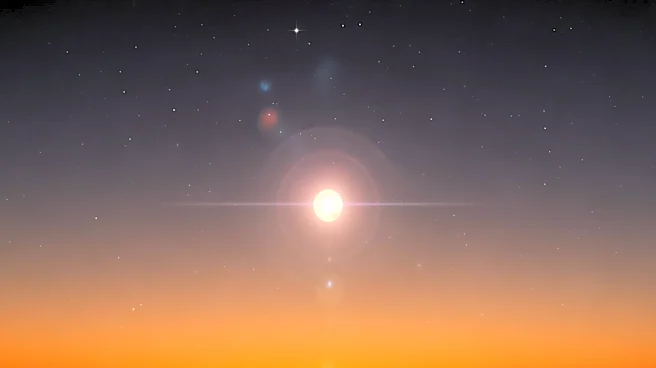
Venus is currently visible as a bright 'Evening Star' in the western sky after sunset, outshining all stars and second only to the Moon in brightness. This celestial display is due to Venus's position east of the Sun, making it visible in the evening
sky. As Venus moves along its orbit, it is gradually catching up with Earth, heading toward an inferior conjunction when it will pass between Earth and the Sun. This movement will cause Venus to appear higher after sunset, grow larger, and become brighter, showcasing phases similar to the Moon.
Why It's Important?
The visibility of Venus offers a unique opportunity for both amateur and professional astronomers to observe one of the brightest objects in the night sky. Its changing phases and brightness provide insights into planetary motion and celestial mechanics. This event also serves as an educational moment, encouraging public interest in astronomy and the natural world. The predictable cycle of Venus's visibility highlights the intricate dance of celestial bodies and their impact on our understanding of the solar system.
What's Next?
In 2026, Venus will continue to dominate the evening sky until October, after which it will fade into the Sun's glare and reappear as the 'Morning Star' in early 2027. Key dates include a conjunction with Jupiter on June 9, reaching its half-phase on August 12, and peak brightness on September 18. These events will likely attract attention from the astronomy community and the public, with potential for organized viewing events and educational programs.