



What's Happening?
Sandia National Laboratories has developed a new robotic system, named SPIINE (Self-Propelled Interior Inspector for Non-destructive-testing Examination), to inspect underground pipes at the Department of Energy's Hanford Site in Washington state. The
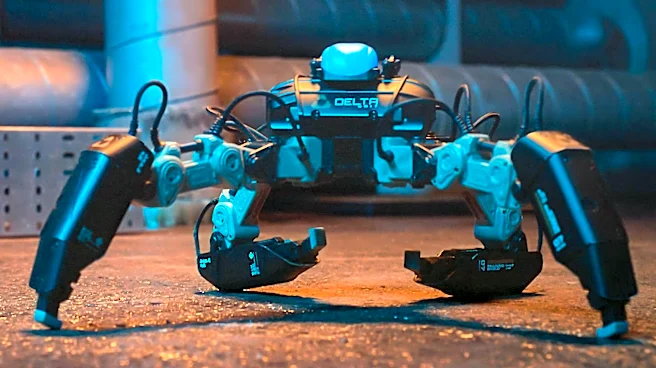
Hanford Site, a former nuclear production complex, houses radioactive waste in underground tanks connected by a network of pipes. These pipes, some as small as two inches in diameter and running for hundreds of feet with multiple 90-degree turns, are difficult to access and inspect using conventional methods. Previous attempts with 'push' cameras could only travel about 10 feet and couldn't navigate tight bends, while traditional ultrasonic probes were too bulky. The SPIINE robot, measuring two by six inches, features a multi-axis body, adaptive wheels, steering capabilities, a high-resolution camera with adjustable LED lighting, and powerful motors. It is designed to carry payloads like ultrasonic or electromagnetic field probes to measure pipe thickness and is controlled by a standard video game controller. The primary goal is to visually inspect for corrosion, cracks, or other damage.
Why It's Important?
The development of the SPIINE robot is crucial for addressing the significant environmental and safety challenges at the Hanford Site. The site's aging pipe network, containing radioactive waste, poses a potential risk if not properly maintained and inspected. Traditional inspection methods have proven inadequate due to the pipes' small diameter, extensive length, and complex geometry. The SPIINE robot offers a solution to access these previously unreachable areas, enabling critical inspections that can identify potential leaks or structural integrity issues before they escalate. This technology helps minimize risks to workers who would otherwise be exposed to hazardous environments and contributes to the long-term environmental cleanup efforts. The ability to conduct thorough internal inspections without costly and disruptive excavation is a major advancement in managing nuclear waste infrastructure, potentially saving significant resources and preventing environmental contamination.
What's Next?
The next phase for the SPIINE robot involves real-world testing at the Hanford Site. While laboratory tests at Sandia have been successful, deployment in the actual environment may reveal new challenges. The development team is already working on several enhancements, including a self-cleaning function for the camera lens and a built-in, fail-safe recovery system in case the robot becomes stuck or disabled. Researchers are also exploring the integration of microscale ultrasonic sensors, as conventional sensors are too large for the tight pipe turns. The team has addressed the 'capstan effect,' which makes it difficult to pull a cable through multiple bends, by designing the system to allow multiple propulsion modules along the cable. The successful implementation of SPIINE could lead to its broader application in other hazardous or inaccessible industrial inspection scenarios.
Beyond the Headlines
The SPIINE robot represents a significant leap in micro-robotics and its application in critical infrastructure maintenance, particularly in hazardous environments. Beyond the immediate benefit of inspecting nuclear waste pipes, this technology highlights the growing trend of using specialized robotics to perform tasks that are too dangerous, difficult, or costly for humans. The flexible design, advanced navigation, and payload capacity of SPIINE demonstrate how robotics can be tailored to highly specific and challenging industrial needs. This innovation could influence future designs for inspecting other types of pipelines, such as those in oil and gas, chemical processing, or even municipal water systems, where internal integrity is paramount. The project also underscores the ongoing commitment of national laboratories like Sandia to leverage advanced technology for national security and environmental protection, showcasing the ethical imperative to safely manage the legacy of past industrial activities.