
What's Happening?
Paleontologists have identified a new fossil snake species, Hibernophis breithaupti, from the White River Formation in Wyoming. This discovery, dating back to the early Oligocene epoch, reveals significant
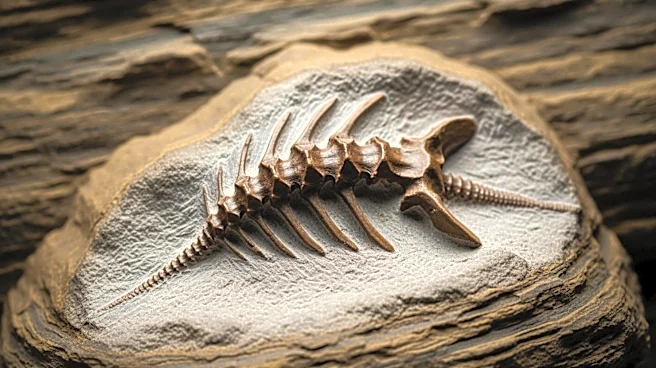
insights into the evolutionary history of boa-like snakes. The fossils, which include nearly complete and articulated specimens, were found in what is believed to be a 34-million-year-old communal burrow. This finding suggests the possibility of ancient group hibernation behavior among snakes. The research, published in the Zoological Journal of the Linnean Society, was led by Michael Caldwell from the University of Alberta and involved collaborators from Australia and Brazil. The study highlights the anatomical details of the fossils, allowing researchers to establish a new genus rather than assigning the specimens to existing categories.
Why It's Important?
The discovery of Hibernophis breithaupti provides crucial insights into the evolutionary dynamics of snakes, particularly the early diversification of boa-like species. This finding challenges previous assumptions about the geographic origins of these snakes, suggesting that the Americas played a more significant role in their early evolution. The potential evidence of ancient communal hibernation behavior also offers a new perspective on the social behaviors of prehistoric reptiles. This research not only enhances the understanding of snake evolution but also contributes to the broader knowledge of reptilian biodiversity and adaptation over millions of years.
What's Next?
Further research is likely to focus on exploring additional fossil sites to confirm the communal hibernation hypothesis and to uncover more about the ecological conditions of the early Oligocene epoch. Scientists may also conduct more detailed phylogenetic analyses to refine the evolutionary tree of boa-like snakes. This could lead to a better understanding of how these species adapted to changing environments and how their behaviors evolved over time.
Beyond the Headlines
The implications of this discovery extend beyond paleontology, touching on broader themes of evolutionary biology and ecology. The potential evidence of ancient social behavior in snakes could influence current understanding of reptilian social structures and their evolutionary significance. Additionally, this research underscores the importance of fossil preservation and the role of advanced technologies, such as CT scanning, in uncovering hidden details within fossil records.