



What's Happening?
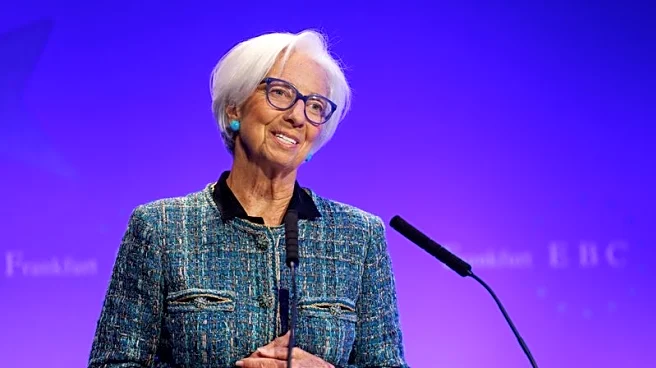
As speculation mounts over Christine Lagarde's potential early departure from the European Central Bank (ECB), discussions are intensifying about who might succeed her. Key contenders include Klaas Knot, the Dutch central bank governor, known for his
fiscal conservatism, and Joachim Nagel, the Bundesbank president. The selection process is expected to involve significant political maneuvering among Eurozone leaders, who will consider candidates' qualifications and political affiliations. The decision will ultimately reflect broader EU political dynamics, as leaders balance national interests and the need for a strong economic leader at the ECB.
Why It's Important?
The selection of the next ECB president is crucial for the Eurozone's economic stability and policy direction. The new leader will influence monetary policy at a time of economic uncertainty and potential challenges such as inflation and fiscal policy coordination. The choice will also signal the EU's economic priorities and political alliances, impacting financial markets and investor confidence. A leader with strong political connections may facilitate smoother policy implementation, while a more independent figure could prioritize economic over political considerations.
What's Next?
As the selection process unfolds, Eurozone leaders will engage in negotiations to reach a consensus on the best candidate. The decision will likely involve trade-offs and compromises, reflecting the complex political landscape of the EU. The outcome will be closely watched by financial markets, as it will provide insights into the future direction of ECB policy. The new president's approach to key issues like interest rates and quantitative easing will be critical in shaping the Eurozone's economic trajectory.