







What's Happening?
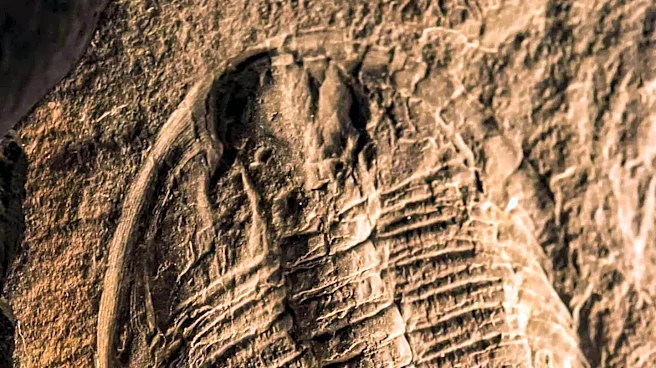
Scientists have identified a tiny fossil, named Eoceras shaanxiense, in southern China’s Shuijingtuo Formation, providing new insights into early ocean life during the early Cambrian period, approximately 540 million years ago. This fossil is recognized
as a cephalopod, a class of mollusks that includes modern squid, octopuses, and nautilus. The Eoceras shaanxiense is significant because it represents the earliest evidence of a 'siphuncle' in cephalopods. A siphuncle is a tube within the shell that regulates liquid and gas, thereby controlling buoyancy. This discovery predates the previously believed first cephalopod, Plectronoceras cambria, by 30 million years. Researchers, led by Junfeng Guo of Chang’an University and Bing Pan of the Chinese Academy of Sciences, classified 32 specimens of 'small shelly fossils' from the formation. Micro-CT imaging and scanning electron microscopy were used to examine the millimeter-long fossils, revealing their internal anatomy, including the segmented tube interpreted as a primordial siphuncle. The study, published in Nature, suggests that this simple flotation system likely kept Eoceras near the seafloor.
Why It's Important?
The discovery of Eoceras shaanxiense is crucial for understanding the evolutionary history of cephalopods and the development of complex biological systems. The siphuncle, a key anatomical feature for buoyancy control and propulsion in later chambered cephalopods, is now traced back to a much earlier, simpler form. This finding helps to bridge gaps in the fossil record, illustrating an intermediate stage in the evolution of this sophisticated system. By providing evidence of a 'candidate primordial cephalopod siphuncle,' the research offers a clearer picture of how early life forms adapted to marine environments and developed mechanisms for survival and mobility. The simplicity of the Eoceras siphuncle suggests that early cephalopods likely had limited movement, staying close to the seafloor, which contrasts with the more vagabond lifestyle of their modern descendants. This insight into early evolutionary sequences contributes to the broader understanding of the Cambrian explosion, a period of rapid diversification of life on Earth.
What's Next?
The research team has open-sourced its raw micro-CT data through the Dryad repository, allowing other experts to freely examine the evidence. This open access will likely encourage further analysis and debate within the paleontological community, potentially leading to new interpretations or corroborations of the findings. Future research may focus on identifying additional transitional fossils that can further elaborate on the evolutionary sequence of the siphuncle and other cephalopod features. Scientists may also explore the environmental conditions of the early Cambrian period in southern China to understand what factors might have driven the development of such anatomical innovations. The study's implications could also extend to broader discussions about the predictability of long-term evolutionary dynamics and the coupling of life with long-term carbon cycle and climate states, as suggested by other recent studies on mass extinctions.
Beyond the Headlines
This discovery highlights the continuous nature of scientific inquiry and the power of advanced imaging technologies in revealing hidden details within ancient fossils. The ability to use micro-CT imaging to reconstruct the internal anatomy of millimeter-long specimens demonstrates how technological advancements are pushing the boundaries of paleontological research. The concept of a 'primordial' siphuncle, with its inherent simplicity, underscores the gradual and incremental nature of evolution, where complex features often arise from simpler precursors. This find also reinforces the importance of fossil discoveries from regions like southern China, which continue to yield exceptionally preserved specimens that are critical for understanding the early diversification of animal life. The ongoing study of such ancient life forms not only enriches our knowledge of Earth's past but also provides a deeper context for understanding the resilience and adaptability of life in the face of environmental changes over geological timescales.