


What's Happening?
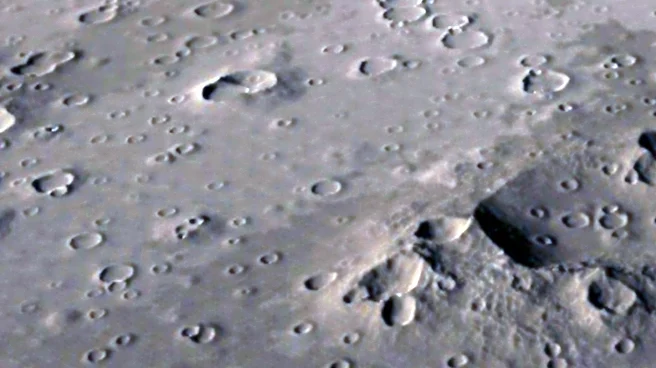
NASA’s Lunar Reconnaissance Orbiter (LRO) has identified the largest newly formed crater ever found in the solar system on the Moon’s eastern edge. Named McGetchin crater after pioneering lunar scientist Tom McGetchin, it formed between April 11 and May
22, 2024, when a comet or asteroid, estimated to be the size of a three- to six-story building, impacted the lunar surface. The crater measures 728 feet wide and 141 feet deep. Robert Wagner, an image-processing specialist with Intuitive Machines working with LROC data, discovered the crater during a routine data-quality check by comparing before and after images of the Moon. Scientists estimate that an impact of this magnitude occurs on the Moon approximately once a century or even less frequently. Further observations using LRO’s thermal instrument, Diviner, revealed a 4-mile-wide area around the crater that is about 16 degrees Fahrenheit cooler at night than its surroundings. This cooling effect is attributed to the impact fluffing up the regolith, making it less dense and less capable of retaining heat.
Why It's Important?
This discovery underscores the dynamic nature of the lunar surface and the continuous bombardment it experiences, even from relatively large objects. The identification of McGetchin crater, and the subsequent thermal anomaly, provides invaluable data for understanding impact mechanics and their long-term effects on planetary bodies without atmospheres. The finding challenges previous assumptions about the frequency of such significant impacts, suggesting they might be rarer than some models predicted. For NASA's Artemis program and future human missions to the Moon, understanding these surface changes is critical. The altered regolith properties, such as reduced density and thermal conductivity, could impact the design of lunar rovers, habitats, and other infrastructure, as well as influence strategies for resource utilization. The extensive 'cold spot' around the crater demonstrates that impacts modify the Moon's surface far beyond the immediate crater, affecting a broader area and potentially influencing local thermal environments.
What's Next?
Scientists will continue to monitor McGetchin crater and its surrounding area using LRO’s instruments to observe any further changes or long-term effects. The data collected from this 'once-in-a-century' event will be crucial for refining impact models and improving predictions of future lunar surface alterations. Researchers will likely conduct further analyses of the thermal data to better understand the physical properties of the 'fluffed up' regolith and its implications for lunar geology and engineering. This information will directly feed into mission planning for future lunar endeavors, including the Artemis program, by informing decisions about landing sites, rover mobility, and the construction of permanent bases. The discovery also highlights the ongoing value of long-duration orbital missions like LRO in providing continuous, high-resolution data that can reveal unexpected and significant events on celestial bodies.
Beyond the Headlines
The discovery of McGetchin crater serves as a stark reminder of the constant cosmic ballet occurring in our solar system, even on seemingly static bodies like the Moon. It emphasizes that planetary surfaces are not immutable but are continually shaped by external forces. This event also highlights the power of persistent scientific observation and data analysis; a 'routine data-quality check' led to a significant astronomical discovery. Ethically, as humanity plans for a sustained presence on the Moon, understanding these dynamic processes becomes paramount for ensuring the safety and longevity of future lunar inhabitants and infrastructure. The Moon, often viewed as a barren wasteland, reveals itself to be a subtly active environment, offering a natural laboratory for studying impact processes that have shaped all rocky bodies in the solar system, including Earth in its early history. This ongoing research contributes to our fundamental understanding of planetary evolution and the potential hazards and opportunities in space.