






What's Happening?
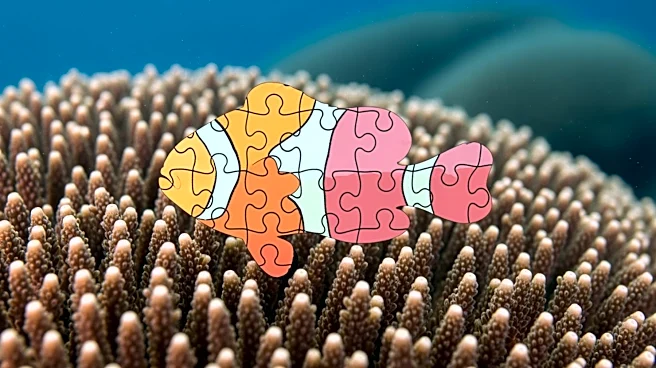
A study has revealed the genetic mechanism behind the unique patterns observed in a mutant clownfish known as 'Snowflake'. This discovery was made by researchers who identified a mutation in a gap junction gene, similar to one found in zebrafish, which
affects pattern formation. The Snowflake clownfish, first noticed in 1999, has wavy white bars instead of the typical straight ones. This pattern has been passed down through generations, prompting scientists to investigate the underlying genetic causes. The study, published in Nature Communications, highlights the role of cell communication in determining animal patterns, using both biological and physical models to explain the phenomenon.
Why It's Important?
Understanding the genetic basis of pattern formation in animals has broader implications for biology and medicine. The findings from the Snowflake clownfish study could provide insights into cellular organization and tissue development in various species, including humans. This knowledge may help in understanding developmental disorders and diseases where cellular communication is disrupted. The research bridges biology and physics, offering a new perspective on how genetic mutations can influence visible traits, potentially leading to advancements in genetic engineering and biotechnology.
What's Next?
Researchers plan to further explore the genetic mechanisms of pattern formation across different species, using the insights gained from the Snowflake clownfish study. This could involve studying other animals with unique patterns to identify common genetic pathways. The findings may also lead to new approaches in genetic research, focusing on the role of cell communication in development and disease. Collaborative efforts with institutions like Kyoto University are expected to continue, aiming to engineer transgenic models for deeper investigation.
Beyond the Headlines
The study not only advances scientific understanding but also highlights the interdisciplinary nature of modern research, combining genetics, evolutionary biology, and physics. It underscores the importance of looking beyond traditional models to explain complex biological phenomena. The Snowflake clownfish serves as a reminder of how small genetic changes can have significant impacts, offering a window into the intricate processes that govern life.