





What's Happening?
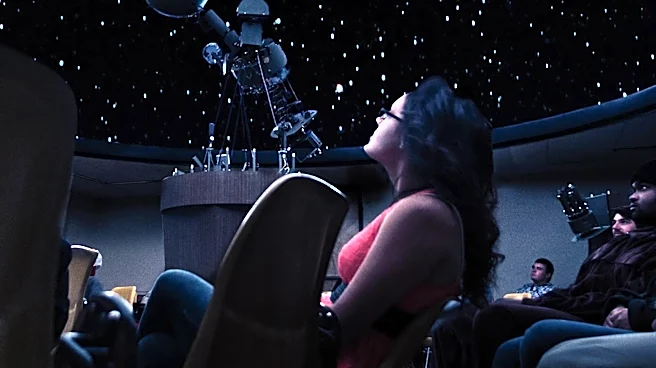
The William M. Thomas Planetarium will present a new show titled 'How Big? How Far?' on November 19 at 7:30 p.m. The program, created by Nick Strobel, aims to provide audiences with a tangible understanding of the vast scales within our solar system and its
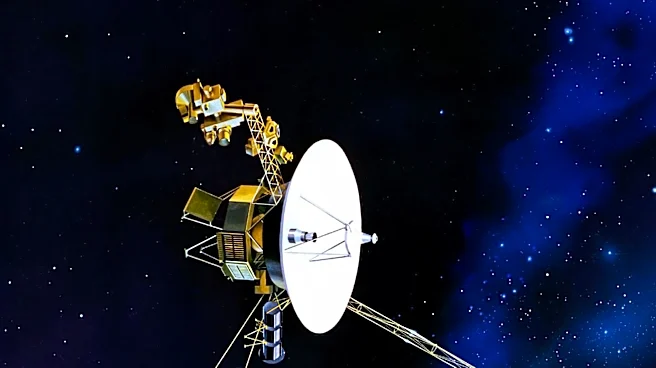
relation to surrounding stars and the Milky Way galaxy. The show will utilize various methods to convey these immense distances, including scale models. For instance, a Nerf basketball represents the sun, with planets scaled down to grains of sand or small coins, and distances paced out across the Bakersfield College Panorama campus. The presentation will also explore travel times between planets using the speed of the New Horizons spacecraft as a reference. Additionally, the show will feature an evening sky tour using the Chronos star projector, highlighting visible planets like Saturn and constellations such as Taurus and Orion, along with details on the Leonid meteor shower peak.
Why It's Important?
This planetarium show is important for public science education, particularly in making complex astronomical concepts accessible and understandable to a general audience. By using relatable scale models and travel time analogies, the program helps demystify the immense distances in space, which are often difficult for individuals to conceptualize. This initiative can foster greater interest in astronomy and science among attendees, including students and families. Understanding the scale of the universe can also provide a broader perspective on Earth's place within the cosmos, potentially inspiring future generations to pursue STEM fields. The inclusion of an evening sky tour further enhances its educational value by connecting theoretical concepts with observable celestial phenomena, encouraging direct engagement with astronomy.
What's Next?
The 'How Big? How Far?' show is scheduled for a single presentation on November 19. Following this event, the William M. Thomas Planetarium may continue to offer similar educational programs focusing on various astronomical topics, depending on public interest and the availability of new content. Planetariums often rotate their shows to cover different aspects of space science, from planetary studies to cosmology. The success of this particular show could influence future programming decisions, potentially leading to more presentations that emphasize scale and distance in the universe. Audiences interested in astronomy can also anticipate future events at the planetarium that will continue to explore celestial phenomena and scientific discoveries.
Beyond the Headlines
The challenge of conveying astronomical scales extends beyond planetarium shows into broader scientific communication. The human mind struggles to grasp magnitudes beyond everyday experience, making effective analogies and visual aids crucial for public understanding of space. This show highlights the ongoing effort by science communicators to bridge this gap, using creative methods to translate abstract scientific data into relatable experiences. Such efforts are vital for maintaining public engagement with scientific research and ensuring that complex discoveries are not confined to academic circles. Furthermore, by illustrating the vastness of space, these programs can subtly influence philosophical perspectives on humanity's place in the universe, encouraging contemplation about existence and exploration.