
What's Happening?
El Niño, a natural climate pattern characterized by warmer-than-average sea surface temperatures in the tropical Pacific Ocean, has intensified to 'Super El Niño' status. This designation occurs when sea surface temperature anomalies
in the tropical Pacific exceed 2.0°C, a threshold that has been met with reported anomalies of 2.5°C. This year's event is considered exceptionally strong, with the National Oceanic and Atmospheric Administration (NOAA) projecting an over 80% chance it could be the strongest since 1950. The phenomenon, named by Peruvian fishermen for its tendency to appear around Christmas, is expected to persist into early 2027. Its influence extends globally, affecting the jet stream and weather patterns across the United States, leading to questions about its impact on winter temperatures, snowfall, and storms. The El Niño-Southern Oscillation (ENSO) cycle, which includes El Niño and its cooler counterpart La Niña, is the largest driver of year-to-year weather variability worldwide.
Why It's Important?
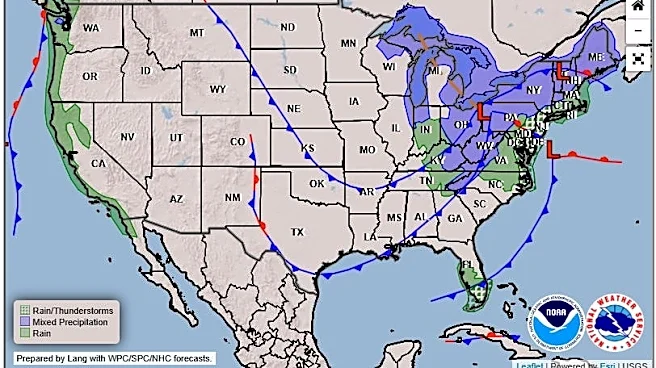
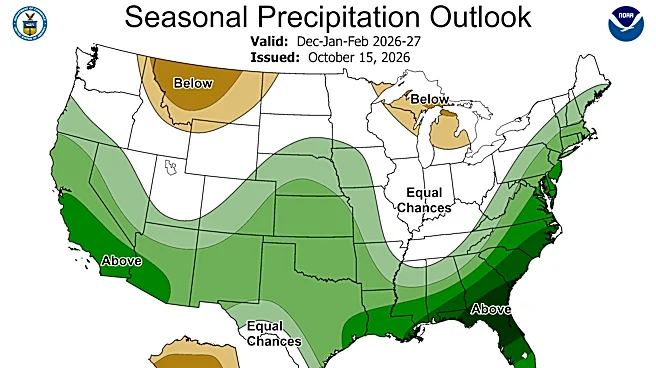
The strengthening of El Niño to 'Super El Niño' status carries significant implications for U.S. weather patterns and various sectors. Historically, strong El Niño events tend to bring wetter conditions to the southern tier of the U.S., including California, Texas, the Gulf Coast, and the Carolinas, while leading to milder patterns in the north. This increased precipitation could help alleviate drought conditions in regions like Texas, recharging soil moisture and potentially reducing irrigation needs for agriculture. However, it also raises the risk of increased coastal storms, flooding, and erosion, particularly in areas like the New Jersey coast and California, where record-shattering ocean warmth is already contributing to elevated sea levels. The altered weather patterns can impact industries such as agriculture, insurance, and tourism, and necessitate preparedness measures from local governments and communities to mitigate potential damages from severe weather events.
What's Next?
The 'Super El Niño' is expected to continue influencing U.S. weather through the winter and into early 2027. Forecasters anticipate an active storm pattern, particularly across the southern U.S., with an increased likelihood of heavy rainfall and potential flooding. Coastal communities, especially in California and New Jersey, are advised to prepare for elevated sea levels and increased coastal erosion, particularly during upcoming 'king tides' in late November, December, and January. While the exact 'personality' of this El Niño event remains to be fully seen, historical data suggests a wetter second half of winter for many regions. Local officials and residents are encouraged to monitor weather forecasts, prepare for potential flooding, and take measures such as clearing drains and securing properties. The interaction between this strong El Niño and long-term climate change is also a subject of ongoing scientific study, with potential for amplified impacts.
Beyond the Headlines
The current 'Super El Niño' highlights the complex interplay between natural climate cycles and human-caused climate change. While El Niño is a natural phenomenon, its impacts are occurring on top of a higher baseline global temperature, which could intensify its effects, such as heavy rainfall and droughts. The record-breaking ocean warmth along the California coast, for instance, is attributed to a combination of the extreme El Niño and pre-existing marine heatwaves amplified by long-term ocean warming. This 'stacking' of factors suggests that future extreme weather events, even those driven by natural cycles, may be more severe. The event also underscores the importance of robust climate modeling and forecasting, as well as community resilience and adaptation strategies, to cope with increasingly unpredictable and intense weather phenomena. The economic and social costs associated with such events, from agricultural losses to infrastructure damage, could continue to rise, prompting deeper discussions on climate adaptation and mitigation policies.