




What's Happening?
Katie Sutton, the Pentagon's assistant secretary of defense for cyber policy, has identified a significant disparity between the demand for cyber operations and the current capabilities of the U.S. military. Speaking at DefenseTalks, Sutton stated that
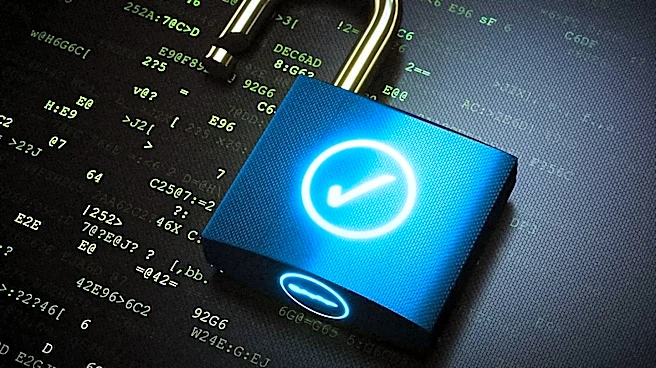
her primary focus is to build a more robust set of cyber capabilities for the Secretary of Defense and the President, acknowledging that 'the demand far exceeds the supply we have.' She noted that while the military gained authority for cyber operations as a traditional military activity in 2018, and capabilities have grown, the past year has seen cyber enter the 'limelight' as an integrated tool of cyber warfare. Sutton emphasized that cyber is not merely a tool to counter malicious actors but is fundamental to every future battle, particularly in denying adversaries access to critical data during kinetic engagements. She also highlighted cyber's role as a tool for leaders to use 'below the level of armed conflict' to provide options before resorting to kinetic actions.
Why It's Important?
This assessment from a top Pentagon official underscores a critical national security challenge for the United States. The widening gap between cyber demand and supply means that the military may not be adequately equipped to address the full spectrum of modern cyber threats, which are constantly evolving. This could leave the nation vulnerable to sophisticated attacks from state-sponsored actors and other adversaries, potentially impacting critical infrastructure, military operations, and national defense. The integration of cyber into traditional warfare, as described by Sutton, signifies a fundamental shift in military strategy, where digital capabilities are as crucial as conventional forces. Failure to bridge this gap could compromise mission success, endanger troops, and limit the options available to the President and Secretary of Defense in responding to global conflicts and provocations. The emphasis on data as fundamental to future battles highlights the strategic importance of information dominance and the need for advanced cyber tools to protect and exploit data effectively.
What's Next?
Sutton's remarks indicate a clear directive for the Pentagon to prioritize the expansion and enhancement of its cyber capabilities. This will likely involve increased investment in cyber talent recruitment, training, and retention, as well as the development and acquisition of advanced cyber technologies. The integration of artificial intelligence (AI) into cyber operations is also a key area of focus, with Sutton advocating for the department to become an 'AI-first organization.' However, she also cautioned about AI-specific risks, such as data poisoning, necessitating a fundamentally different approach to cyber operations compared to past internet development. This suggests that future initiatives will need to balance innovation with robust security measures. The Pentagon will likely collaborate with academic institutions, private sector companies, and international partners to accelerate the development of cutting-edge cyber solutions and address the workforce shortage. The goal will be to ensure that the U.S. military maintains a decisive advantage in the digital domain and can effectively protect national interests in an increasingly complex geopolitical landscape.
Beyond the Headlines
The Pentagon's struggle to meet cyber demand reflects a broader national challenge in the U.S. to cultivate a skilled cybersecurity workforce. This issue extends beyond the military to critical infrastructure sectors, government agencies, and private industries, all of which face persistent cyber threats. The call for an 'AI-first organization' within the Pentagon signals a recognition of AI's transformative potential in warfare, but also its inherent risks. This raises ethical and strategic questions about the responsible development and deployment of AI in military contexts, particularly concerning autonomous systems and decision-making processes. The historical context of prioritizing speed over security in internet development, as mentioned by Sutton, serves as a cautionary tale for the AI era, emphasizing the need for a 'security-first' approach from the outset. This shift will require not only technological advancements but also a cultural change within defense institutions to embrace continuous learning, adaptation, and collaboration to stay ahead of adversaries in the rapidly evolving cyber landscape.