





What's Happening?
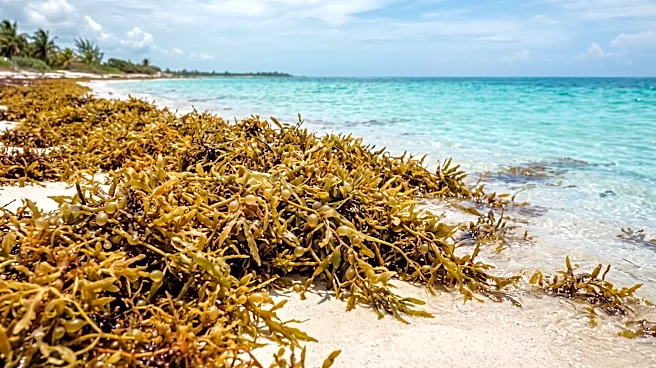
The Development Bank of Latin America and the Caribbean (CAF) and the Global Environment Facility (GEF) have launched 'SargMarine,' a regional project aimed at addressing massive sargassum influxes in the Greater Caribbean. The initiative, presented at COP31,
is financed by a $10 million GEF grant, with an additional $67.3 million in co-financing. The Organization of American States (OAS) will serve as the executing agency for the project, while CAF will be the implementing agency, and the Inter-American Institute for Global Change Research (IAI) will act as a technical partner. The project's primary goals include facilitating information sharing, strengthening countries' capacity to anticipate and manage sargassum influxes, and developing alternative productive uses for the seaweed to create economic opportunities for local communities. The initiative will support Jamaica, Colombia, Panama, the Dominican Republic, Trinidad and Tobago, Grenada, and Saint Lucia.
Why It's Important?
The massive influx of sargassum poses a significant threat to the marine and coastal ecosystems, tourism, fisheries, and economic activities across the Caribbean. According to the United Nations Environment Programme, 37.5 million tonnes of sargassum were recorded in the Atlantic in May 2025, marking the highest volume since monitoring began in 2011. This phenomenon impacts the U.S. indirectly through its effects on regional stability, tourism, and trade with Caribbean nations. The SargMarine project is crucial because it emphasizes a regional, coordinated approach to a transboundary problem, which individual national responses have proven insufficient to tackle. By strengthening early warning systems and fostering cooperation, the project aims to mitigate the environmental and economic damage caused by sargassum, thereby safeguarding the livelihoods of coastal communities and the region's vital tourism industry. The involvement of the OAS as the executing agency highlights the diplomatic and collaborative effort required to address such large-scale environmental challenges.
What's Next?
With final approval already secured, the SargMarine initiative is ready for immediate implementation. The project will focus on strengthening monitoring and forecasting capabilities to better predict sargassum arrivals, allowing affected countries to concentrate protection efforts and plan for productive uses of the seaweed. Key stakeholders, including Jamaica's Special Envoy for Climate Change, Environment, Oceans and the Blue Economy, Matthew Samuda, and the Dominican Republic's Vice Minister for Climate Change and Sustainability, Ana Emilia Pimentel, have emphasized the importance of improved forecasting and considering community needs alongside economic consequences. The project is expected to foster more coordinated monitoring, preparedness, and response mechanisms among Caribbean countries. The success of SargMarine could serve as a model for international cooperation in addressing other transboundary environmental challenges, potentially influencing future U.S. engagement in regional environmental initiatives.
Beyond the Headlines
The sargassum crisis in the Caribbean is a stark indicator of broader climate change impacts and ocean health degradation. Beyond the immediate economic and environmental damage, the persistent influxes of sargassum can lead to long-term ecological shifts, affecting biodiversity and the delicate balance of marine ecosystems. The project's focus on developing 'productive uses' for sargassum, such as in agriculture or bioenergy, represents an innovative approach to turning an environmental problem into an economic opportunity. This could spur new industries and research in the region, potentially attracting international investment and expertise. However, the ethical considerations of large-scale sargassum harvesting and processing, including potential impacts on marine life and coastal environments, will need careful management. The collaborative framework established by CAF, GEF, and OAS also underscores the increasing recognition that complex environmental issues necessitate multilateral solutions, moving beyond national borders to address shared vulnerabilities and build collective resilience.