








What's Happening?
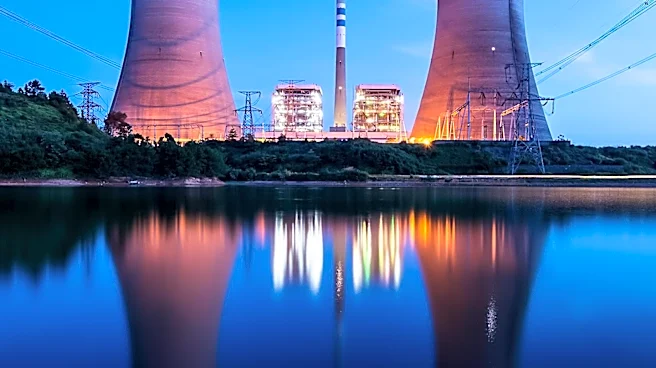
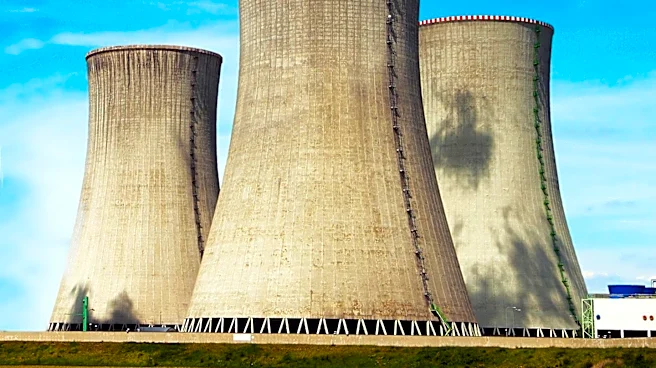
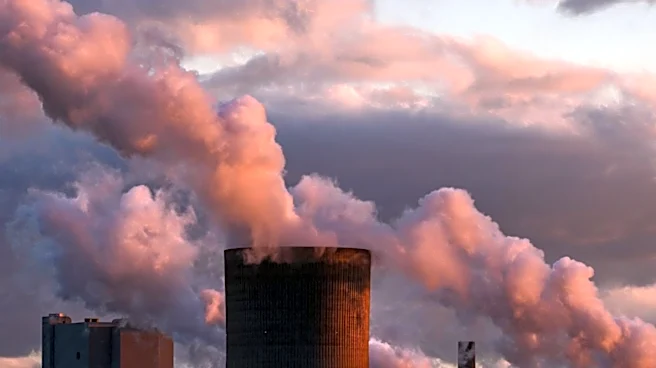
China has commenced construction on its first Hualong One nuclear reactor featuring cooling towers in the eastern province of Shandong. This development marks the initial phase of a new nuclear power plant designed to supply electricity to five million
people. The Hualong One reactor is a third-generation nuclear reactor developed domestically in China, a joint effort by the China General Nuclear Power Group (CGN) and China National Nuclear Corporation (CNNC). It boasts a 177-core assembly design, a net power output of 1090 MWe, and an operational lifespan of 60 years. This particular facility, the Zhaoyuan nuclear power station, is notable as it will be the first Hualong One reactor to utilize cooling towers for steam condensation, a departure from the typical method of drawing water from nearby bodies. China has approved 46 new nuclear power plants during its 14th Five-Year Plan (2021-2025) and aims to generate 135 million kilowatts from 120 nuclear power units currently in various stages of approval, construction, or operation.
Why It's Important?
This expansion of China's nuclear power capabilities has significant implications for global energy markets and environmental policy. While the U.S. remains the largest producer of nuclear power, China's aggressive investment in nuclear energy signals a strategic shift towards cleaner energy sources and away from its coal-dependent economy. This move could position China as a leader in nuclear technology and deployment, potentially influencing international standards and competition in the energy sector. For the U.S., China's rapid nuclear development highlights differing approaches to energy security and climate change mitigation. The U.S. has recently scaled back some of its net-zero targets, while China is accelerating its transition to non-fossil fuel energy. This divergence could impact geopolitical dynamics, trade relations, and the global effort to combat climate change, as China's increased nuclear capacity will reduce its carbon emissions, potentially setting a new benchmark for other developing nations.
What's Next?
The construction of the Zhaoyuan nuclear power station's first phase, including two Hualong One reactors with cooling towers, is underway. The raft foundation for Unit 2 has begun, involving a substantial concrete pour over 60 hours. As these reactors become operational, China will continue to integrate them into its national grid, increasing its clean energy output. Future developments will likely include the continued approval and construction of additional nuclear power units across China, as outlined in its 14th Five-Year Plan. This sustained investment suggests a long-term commitment to nuclear power as a cornerstone of China's energy strategy. The performance and safety record of these new Hualong One reactors, particularly those utilizing cooling towers, will be closely monitored by the international community, potentially influencing nuclear energy development in other countries.
Beyond the Headlines
The adoption of cooling towers for the Hualong One reactor at the Zhaoyuan plant represents an important technological adaptation. Traditionally, Hualong One reactors have used large amounts of water from nearby bodies for cooling. The shift to cooling towers indicates a potential strategy to enable nuclear plant construction in regions with limited water resources or to mitigate environmental impacts on local aquatic ecosystems. This innovation could broaden the geographical feasibility of nuclear power plant deployment. Furthermore, China's indigenous development of the Hualong One reactor underscores its growing self-sufficiency in advanced nuclear technology, reducing reliance on foreign expertise and potentially offering its technology to other nations. This could reshape the global nuclear energy supply chain and influence the geopolitical landscape of energy independence and technological leadership.