




What's Happening?
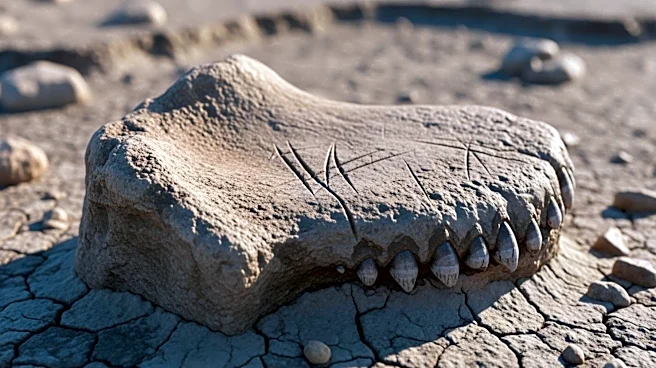
A recent study on the dental fossils of the Maiasaura peeblesorum, a duck-billed dinosaur, suggests that these creatures exhibited bird-like parental care. Researchers analyzed the wear patterns on the teeth of juvenile and adult Maiasaura, finding that juveniles
had more crushing wear, while adults showed more shearing wear. This indicates that adult dinosaurs may have provided softer, more nutritious food to their young, similar to modern birds. The study, conducted by John Hunter and his team at The Ohio State University, provides new insights into the social behaviors of dinosaurs and their evolutionary history.
Why It's Important?
The findings offer a deeper understanding of dinosaur social structures and their evolutionary parallels with modern birds. By revealing that dinosaurs like the Maiasaura may have engaged in complex parental care, the study challenges previous assumptions about dinosaur behavior. This research could reshape how scientists view the evolution of social behaviors in animals, providing a link between ancient and modern species. It also highlights the importance of dental analysis in paleontology, offering a new method to study ancient ecosystems and animal interactions.
What's Next?
Future research may focus on examining other dinosaur species to determine if similar parental care behaviors were widespread. Scientists could also explore the implications of these findings on the growth and development of juvenile dinosaurs. Additionally, further studies might investigate the environmental factors that influenced these behaviors, providing a more comprehensive picture of dinosaur life. The research opens new avenues for understanding the evolutionary history of social behaviors in vertebrates.