
What's Happening?
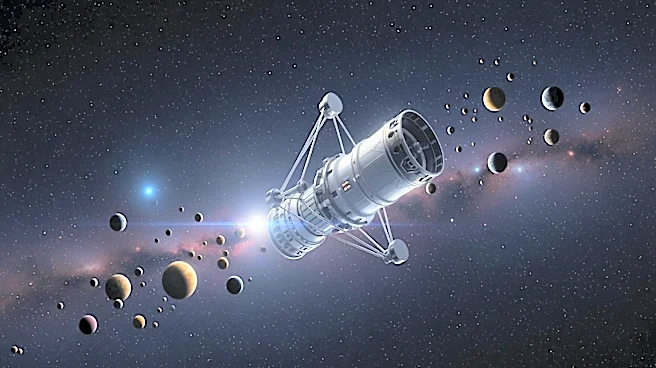
The James Webb Space Telescope (JWST) has been studying the TOI-700 system, a nearby planetary system with Earth-sized worlds, to detect an Earth-moon analog. However, the search has been complicated by stellar
noise from the system's star, which obscures potential signals of a moon. The TOI-700 system, located about 100 light-years away, includes planets within the habitable zone, making it a prime target for finding moons similar to Earth's. Despite JWST's advanced capabilities, the star's activity has created a noise pattern that masks weaker signals, preventing definitive evidence of a moon from being detected.
Why It's Important?
Detecting an exomoon in the TOI-700 system would be a significant step in understanding planetary habitability and the dynamics of planetary systems. Moons play a crucial role in stabilizing a planet's axial tilt and influencing climate patterns. The inability to detect such moons due to stellar noise highlights the challenges faced by astronomers in distinguishing between celestial signals and stellar activity. This underscores the need for advanced data analysis techniques to filter out noise and improve detection capabilities.
What's Next?
Researchers are exploring methods to remove stellar noise from the data, which could reveal hidden signals of exomoons. The development of advanced algorithms capable of filtering out red noise could unlock discoveries within existing datasets. This shift from observation to computation may lead to breakthroughs in exomoon detection without the need for new observations. Continued analysis of the TOI-700 system and similar targets will be crucial in advancing our understanding of exoplanetary systems.