








What's Happening?
Scientists at the United States Geological Survey (USGS) have discovered that certain metal-rich rocks retrieved from the deep ocean can spontaneously ignite when exposed to air and during processing. This finding, detailed in a study published in Nature's
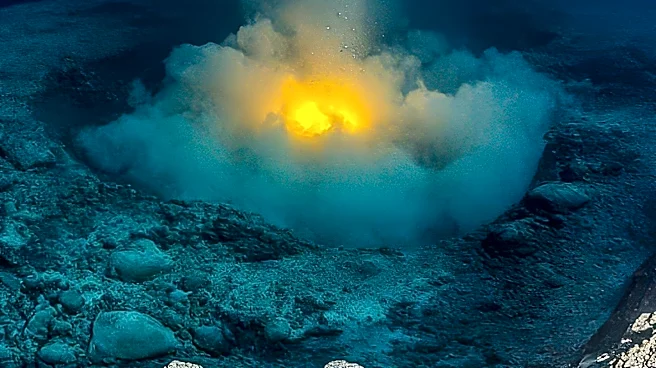
Scientific Reports, emerged from a 2022 research expedition to the Escanaba Trough off the Oregon–California border. During laboratory work, two of 57 hydrothermal rock samples caught fire, producing temperatures exceeding 100 degrees Celsius and fully oxidizing the material. The research indicates that heat generation through exothermic reactions, previously unexamined in seafloor massive sulfide deposits, could lead to rapid fires on ships involved in deep-sea mining. The inquiry pinpointed nanocrystalline marcasite, an unstable iron sulfide form, as the probable cause of these reactions. The USGS, in collaboration with the Bureau of Ocean Energy Management and the National Oceanic and Atmospheric Administration, gathered these samples using a remotely operated vehicle.
Why It's Important?
This discovery introduces significant occupational safety challenges for the nascent deep-sea mining industry, which is already under scrutiny for its potential environmental impacts. The spontaneous combustion risk means that standard methods for handling sulfide ores, typically used for land-based mining, may be insufficient for deep-sea materials. The potential for heat buildup aboard vessels, especially where large quantities of crushed sulfide rock could be concentrated in enclosed spaces, poses a direct threat to personnel and equipment. This adds a critical safety dimension to an industry driven by the increasing demand for metals like copper, zinc, gold, and silver, essential for infrastructure, manufacturing, and energy technologies. The findings will likely influence the development of new safety standards and operational procedures, potentially increasing the cost and complexity of deep-sea mining projects. Companies like The Metals Company and Deep Sea Minerals, which are exploring deep-sea resources, will need to address these newly identified risks.
What's Next?
The USGS research suggests that further testing will be required to determine the prevalence of reactive marcasite in seabed deposits and to assess whether laboratory results translate into similar hazards during industrial operations. Operators in the deep-sea mining sector will likely need to evaluate mineral stability before extraction and develop specific procedures for handling, storing, and transporting potentially reactive materials. This could involve implementing new safety protocols, investing in specialized equipment, and conducting more extensive pre-mining assessments. The International Seabed Authority, which has granted exploration contracts for polymetallic sulfide deposits, may also need to consider these findings when formulating regulations for commercial extraction. The industry will face increased pressure to demonstrate that it can mitigate these safety risks alongside addressing environmental concerns raised by various groups.
Beyond the Headlines
The discovery of spontaneously igniting deep-sea rocks highlights a broader challenge in exploiting novel resources: the unpredictable nature of materials from extreme environments. Unlike minerals extracted from stable terrestrial conditions, seafloor sulfide rocks undergo significant environmental shifts—including exposure to oxygen and changes in temperature, pressure, and moisture—when brought to the surface. This research underscores the need for comprehensive scientific understanding of these materials before large-scale commercial extraction proceeds. It also brings to light the ethical considerations of venturing into deep-sea environments, where the full range of physical and chemical properties of resources, as well as their ecological impacts, are still largely unknown. The findings could trigger a re-evaluation of the risk-benefit analysis for deep-sea mining, potentially slowing down its development until robust safety and environmental protocols are firmly established.