








What's Happening?
NASA's Curiosity rover has made a groundbreaking discovery on Mars, identifying the most diverse collection of organic molecules ever found on the planet. The rover drilled a rock sample, nicknamed 'Mary Anning 3', on Mount Sharp, an area once covered
by lakes and streams. This sample revealed 21 carbon-containing molecules, seven of which were detected for the first time on Mars. Among these are nitrogen heterocycles, which are considered precursors to RNA and DNA, and benzothiophene, a molecule found in many meteorites. These findings suggest that ancient Mars had the right chemistry to support life. The discovery was made using the Sample Analysis at Mars (SAM) instrument, which employs a high-temperature oven to analyze rock compositions. The results are detailed in a paper published in Nature Communications.
Why It's Important?
The discovery of these organic molecules is significant as it enhances the understanding of Mars' potential to have supported life in its ancient past. The presence of nitrogen heterocycles and benzothiophene indicates that Mars had the necessary chemical precursors for life. This finding contributes to the broader search for life beyond Earth, providing insights into the planet's geologic and potentially biologic history. The ability to detect such complex molecules also demonstrates the advanced capabilities of the Curiosity rover and the SAM instrument, paving the way for future missions to explore Mars and other celestial bodies for signs of life.
What's Next?
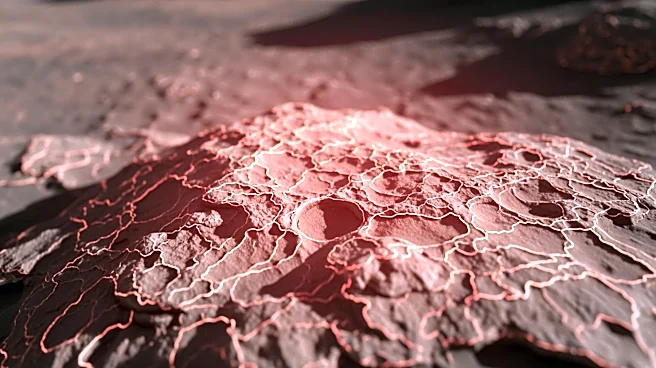
Following this discovery, the Curiosity mission team plans to continue analyzing the results from the rover's exploration of weblike boxwork ridges, formed by ancient groundwater. These analyses will be detailed in future peer-reviewed papers. Additionally, the techniques developed for SAM will be applied to future missions, including the European Space Agency's Rosalind Franklin Mars rover and NASA's Dragonfly mission to Saturn's moon Titan. These missions will further explore the potential for life in the solar system using similar wet chemistry techniques.
Beyond the Headlines
The discovery of organic molecules on Mars not only advances scientific understanding but also raises questions about the ethical and philosophical implications of finding life beyond Earth. It challenges humanity's perception of its place in the universe and could influence future space exploration policies. The ability to detect and analyze such molecules also highlights the importance of international collaboration in space exploration, as future missions will involve partnerships between NASA and other space agencies.