





What's Happening?
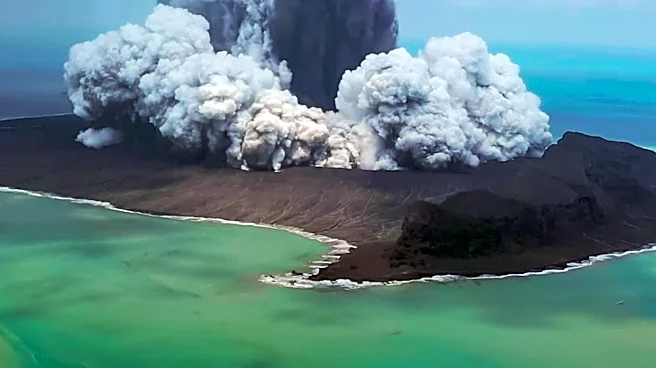
Professor Bill McGuire, a volcanologist, has issued a warning regarding the potential for a 'megatsunami' that could impact the U.S. East Coast. This catastrophic event is linked to the Cumbre Vieja volcanic ridge on the island of La Palma in the Canary
Islands, Spain. McGuire's extensive studies suggest that a significant portion of the volcano's flank could eventually collapse into the North Atlantic Ocean. Computer modeling indicates that such a collapse could generate massive waves, potentially reaching 65 feet in height along America's eastern seaboard, submerging coastal settlements within approximately nine hours of the event. While the Cumbre Vieja last erupted in 2021, causing significant destruction on La Palma, the potential flank collapse is a separate, long-term concern.
Why It's Important?
This warning carries significant implications for the U.S. East Coast, particularly for its densely populated coastal cities and critical infrastructure. A 65-foot tsunami would cause unprecedented devastation, leading to immense loss of life, widespread property damage, and long-term economic disruption. Industries reliant on coastal access, such as shipping, tourism, and fishing, would be severely impacted. The potential for such an event, even if centuries away, necessitates long-term planning and preparedness strategies for coastal communities and emergency management agencies. The scientific debate surrounding the likelihood and timing of such a collapse underscores the challenges in assessing and mitigating low-probability, high-impact natural disasters.
What's Next?
While Professor McGuire emphasizes that the event is not imminent and could be centuries or even millennia away, the scientific community will likely continue to monitor the Cumbre Vieja volcano for any signs of instability. Further research and modeling may be conducted to refine predictions regarding the potential scale and impact of a flank collapse and subsequent tsunami. For U.S. coastal regions, this information could inform long-term urban planning, infrastructure development, and disaster preparedness initiatives, even if the immediate threat is low. Public awareness campaigns about tsunami risks, though perhaps not directly tied to this specific long-term threat, remain crucial for general safety.
Beyond the Headlines
The discussion around the Cumbre Vieja 'megatsunami' highlights the profound interconnectedness of global geological processes and their potential far-reaching consequences. It raises ethical questions about how societies should prepare for extremely rare but catastrophic natural events that may not occur for generations. The scientific debate itself, sometimes described as 'heated,' reflects the complexities and uncertainties inherent in predicting geological phenomena on such vast timescales. This scenario also underscores the importance of international scientific collaboration in monitoring and understanding global hazards, as a geological event in one part of the world could have devastating effects thousands of miles away.