



What's Happening?
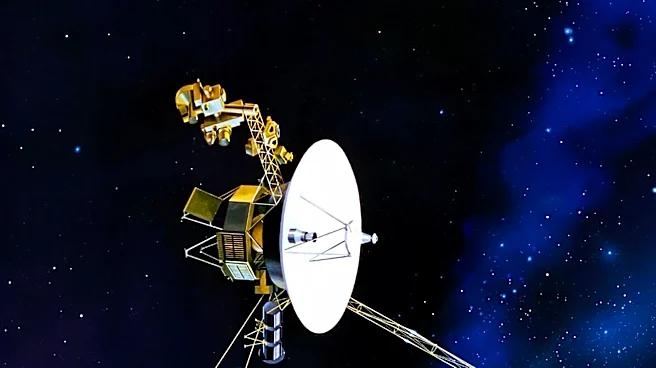
NASA's Pioneer 10 and 11 probes, launched in the early 1970s, and the Voyager 1 and 2 probes, launched in 1977, carry humanity's first physical messages into interstellar space. The Pioneer probes are equipped with plaques designed by Carl Sagan and Frank
Drake, which depict humanity and Earth's location. The Voyager probes carry Golden Records, also conceived by Sagan and Drake, containing sounds and images representing Earth's diversity of life and culture. These messages are intended for potential extraterrestrial civilizations or future human explorers. The Pioneer plaques are six-by-nine-inch gold-anodized aluminum plates with engraved pictorial messages, while the Voyager Golden Records are 12-inch gold-plated copper disks with encoded images and sounds. These missions marked a significant step in humanity's attempt to communicate beyond Earth and share information about our civilization.
Why It's Important?
These interstellar messages represent a profound human endeavor to connect with potential life beyond Earth and to leave a legacy for future generations. The Pioneer Plaques and Voyager Golden Records symbolize humanity's curiosity, scientific ambition, and desire to share its story with the cosmos. They highlight the philosophical questions surrounding extraterrestrial intelligence and our place in the universe. The creation of these messages involved prominent scientists like Carl Sagan and Frank Drake, underscoring the scientific community's commitment to the search for extraterrestrial life. These artifacts also serve as time capsules, preserving a snapshot of Earth's life and culture for billions of years, potentially offering insights to future beings about our existence.
What's Next?
The Pioneer 10 and 11 probes are continuing their journeys, with Pioneer 10 expected to reach Aldebaran in over two million years and Pioneer 11 heading towards the Aquila constellation. Voyager 1 and 2 have already exited the heliosphere and entered interstellar space. While these probes are unpowered and cannot send data back to Earth, their messages continue to travel through the cosmos. The legacy of these missions has inspired modern efforts, such as the message attached to the Europa Clipper mission, which carries a plaque with a poem and waveforms of the word 'water' in various languages. These ongoing and future missions continue the tradition of sending messages into space, reflecting humanity's enduring hope for discovery and connection.
Beyond the Headlines
The creation and launch of these interstellar messages raise deeper ethical and philosophical questions about humanity's role in the universe. The debate surrounding Messaging Extraterrestrial Intelligence (METI) continues, with discussions about the potential risks and benefits of actively broadcasting our presence. These messages also reflect a shift in human consciousness, moving from a geocentric view to a cosmological perspective, where humanity considers itself part of a larger cosmic tapestry. The act of sending these messages is not just about potential reception by aliens, but also about humanity's self-reflection and its aspirations for the future. They embody a universal desire to understand and be understood, transcending temporal and spatial boundaries.