
What's Happening?
Researchers from the Massachusetts Institute of Technology have uncovered evidence of ancient Roman self-healing concrete techniques at a construction site in Pompeii. The site, preserved by the eruption
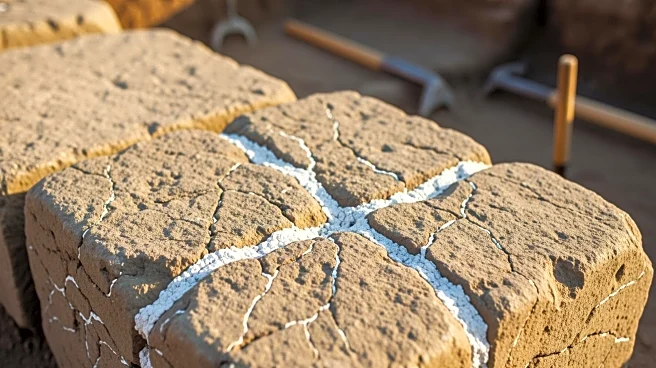
of Mount Vesuvius in 79 CE, revealed that Roman builders used a method called 'hot mixing' to create durable concrete. This process involved pre-mixing quicklime with volcanic ash, known as pozzolana, before adding water, resulting in an exothermic reaction that produced high temperatures in the mortar. The presence of lime clasts in the concrete allowed it to self-repair when cracks formed, as water would trigger a reaction that released calcium to fill the cracks. This discovery provides new insights into Roman engineering practices and aligns with ancient texts by Pliny the Elder, which describe the intense heat generated during the mixing process.
Why It's Important?
The discovery of self-healing concrete techniques used by ancient Romans has significant implications for modern construction and materials science. Understanding these ancient methods could lead to the development of more durable and sustainable building materials today. The ability of Roman concrete to self-repair could inspire innovations in infrastructure that reduce maintenance costs and extend the lifespan of structures. This research also highlights the advanced engineering capabilities of ancient civilizations, challenging modern assumptions about historical technological progress. The findings could influence contemporary architectural practices and encourage further exploration of historical construction techniques.
What's Next?
Further research is likely to explore the extent of the use of hot mixing in Roman construction and its potential applications in modern engineering. Scholars may investigate other archaeological sites to determine how widespread this technique was and whether it was adapted to different environmental conditions. The study could also prompt a reevaluation of ancient texts and historical records to uncover more details about Roman building practices. Additionally, there may be interest in replicating these ancient methods in contemporary construction projects to test their efficacy and sustainability.