







What's Happening?
The University of California Regents have approved requests for military-grade weaponry, including approximately 11,000 rifle rounds, 1,950 pepper-ball projectiles, and additional drones, for police departments at five UC campuses: UCLA, Riverside, San
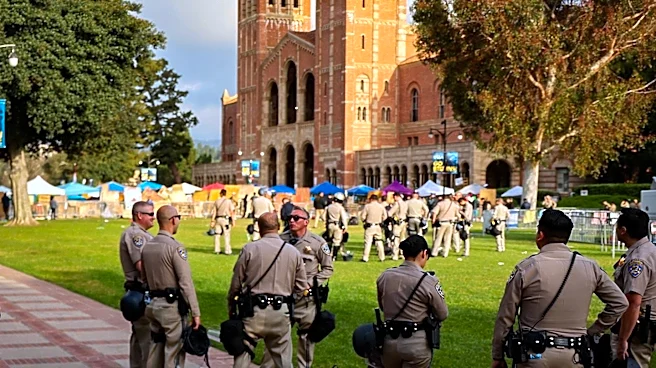
Diego, Santa Barbara, and Merced. Officials cited training needs, campus growth, and security preparations for the 2028 Los Angeles Olympics as reasons for the acquisitions. UCLA, which expects to house around 17,000 athletes and support staff for the Games, specifically requested an expansion of its emergency response drone fleet and additional 40-millimeter foam-tipped rounds. The purchases, which are commercially available law enforcement equipment rather than direct acquisitions from the U.S. Department of Defense, were approved under a state law requiring governing board consent for such equipment. The requests have drawn opposition from faculty and community members, particularly concerning the use of 40-millimeter foam-tipped projectiles, which critics argue can cause serious injury or death.
Why It's Important?
This decision highlights the ongoing debate surrounding police militarization, particularly within academic institutions. The acquisition of such equipment, especially less-lethal projectiles like foam-tipped rounds, raises concerns about potential escalation of force during protests or other campus incidents. The opposition from faculty and community members underscores a significant divide between university administration's security priorities and the community's desire for less confrontational policing. The context of the 2028 Olympics adds another layer of complexity, as universities prepare for large-scale international events that demand heightened security measures. This move could set a precedent for increased militarization of campus police forces across the nation, potentially altering the relationship between students, faculty, and law enforcement on university grounds and impacting free speech and assembly rights.
What's Next?
The approved purchases will proceed, with campus police departments funding the equipment from their annual budgets. The University of California Office of the President also requested four command vehicles, for which it received a $2.05 million federal grant, to be used for coordinating responses to emergencies and large events like the Olympics. The ongoing scrutiny of UC policing, particularly after armed responses to 2024 pro-Palestinian protests, suggests that these new acquisitions will likely face continued public and internal oversight. Activist groups and faculty members are expected to monitor the deployment and use of this equipment closely, potentially leading to further protests or legal challenges. The debate over police tactics and equipment on university campuses is likely to intensify as the 2028 Olympics approach.
Beyond the Headlines
The decision to equip campus police with military-grade weapons reflects a broader trend of increased security measures in public spaces, often driven by concerns over mass violence and large-scale events. However, it also raises fundamental questions about the role of police on university campuses, traditionally seen as forums for open discourse and intellectual freedom. The use of such equipment, particularly during student protests, could lead to a chilling effect on free speech and assembly, transforming campuses into more controlled environments. The legal implications are also significant, especially given that a federal judge has barred the Los Angeles Police Department from using similar 40-millimeter launchers for crowd control. This disparity in permissible force between municipal and university police forces could lead to legal challenges regarding equal protection and safety standards for university communities.