



What's Happening?
Astronomers have identified a powerful 'mega-laser' signal that has traveled over 8 billion light-years to reach Earth, maintaining its strength throughout the journey. This signal, detected using the MeerKAT radio telescope in South Africa, challenges
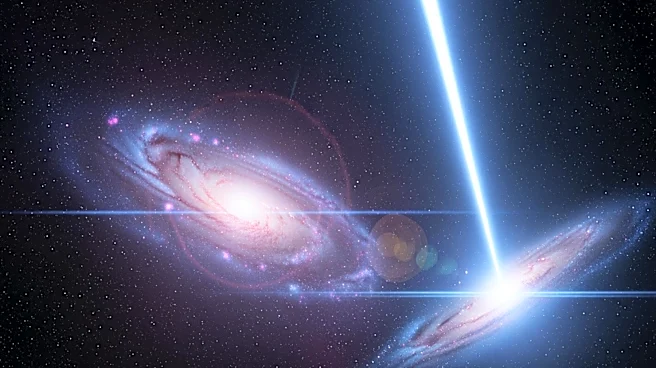
existing scientific predictions about signal behavior over vast cosmic distances. Typically, signals weaken and distort as they traverse space, but this one remained bright and detectable. The signal is a hydroxyl megamaser, a natural occurrence of microwave amplification similar to lasers but in radio wavelengths, resulting from galactic collisions. The radiation originates from the HATLAS J142935.3-002836 galaxy system, located about 8 billion light-years away. Researchers believe the signal's intensity qualifies it as a 'gigamaser,' even more intense than typical megamasers. The signal's detection was aided by gravitational lensing, where a foreground galaxy magnifies the signal from behind it.
Why It's Important?
This discovery could significantly reshape our understanding of energy and radiation behavior across the universe. The ability of the signal to remain intact over such a long distance suggests new insights into cosmic phenomena and the potential for studying the universe at earlier stages. The detection of such signals can provide valuable information about gas-rich environments and supermassive black holes. Additionally, this finding opens up possibilities for detecting gravitational waves in the future. The discovery highlights the unpredictable and vibrant nature of the universe, offering new opportunities for scientific exploration and understanding.
What's Next?
Researchers hope to find more signals like this one, aiming to discover hundreds to thousands of similar systems. As technology advances and telescopes like MeerKAT are developed, scientists are beginning to uncover more secrets of the universe. This could lead to a better understanding of cosmic phenomena and potentially new possibilities within the universe.