


What's Happening?
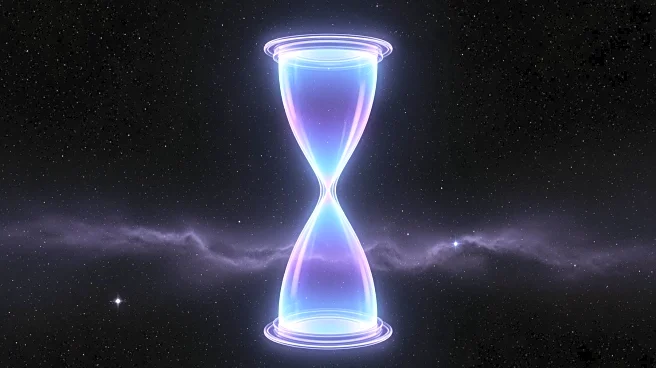
Astronomers have identified an unusual hourglass-shaped structure in the galaxy ESO 130 G012, located approximately 55 million light-years from Earth. This discovery was made using radio images from Australia's ASKAP telescope as part of the Evolutionary
Map of the Universe project. The structure, which extends nearly 160,000 light-years, appears as a faint form above and below the galaxy's disc. It is characterized by material flowing upward from the galactic plane and spreading outward, forming a wide funnel on both sides. The waist of the hourglass aligns with the star-forming disc of the galaxy, which is not undergoing rapid star formation, producing only about 0.2 solar masses of stars per year. The presence of a central black hole, estimated to be 50 million solar masses, adds another layer of complexity to the findings.
Why It's Important?
This discovery challenges existing theories about galaxy evolution, particularly the notion that only violent starbursts can drive large-scale galactic winds. The hourglass structure suggests that steady star formation, along with stellar winds and supernova explosions, might be sufficient to create such outflows over time. The presence of a central black hole, which appears inactive now, raises the possibility that past activity could have contributed to the structure. This finding is significant because it provides a new perspective on how galaxies evolve and interact with their surrounding environments. It also highlights the potential for ordinary galaxies to harbor complex histories that are not immediately visible in optical images.
What's Next?
Further research is needed to determine the exact mechanisms behind the formation of the hourglass structure. Astronomers will likely conduct more detailed observations to explore the role of the central black hole and the potential for past energetic events. The galaxy ESO 130 G012 presents a unique opportunity to study the connection between galactic disks and their surrounding halos, offering insights into energy transfer processes within galaxies. These studies could refine models of galaxy evolution and improve our understanding of how galaxies develop over time without dramatic triggers.
Beyond the Headlines
The discovery of the hourglass structure in ESO 130 G012 underscores the importance of radio astronomy in uncovering hidden features of galaxies. It also raises questions about the prevalence of such structures in other seemingly ordinary galaxies. This finding could lead to a reevaluation of how astronomers interpret galactic activity and the factors that influence the formation of large-scale structures in the universe. Additionally, it highlights the potential for galaxies to retain evidence of past events that are not immediately apparent in visible light, suggesting a more complex and nuanced picture of galactic history.