






What's Happening?
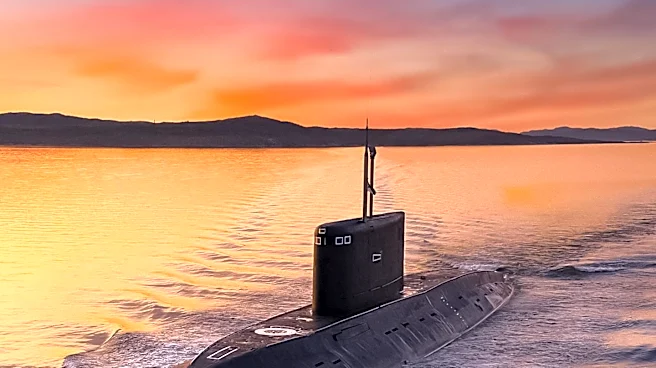
Israel's sixth submarine, the INS Drakon, has commenced its journey from Germany to Israel, with its arrival anticipated within weeks. A send-off ceremony was held at the TKMS shipyard in Kiel, marking the culmination of years of collaborative planning
and construction between Israel and Germany. The INS Drakon is the final vessel in the Dolphin-class AIP series acquired by the Israeli Defense Ministry for the Israeli Navy. According to the IDF, this submarine incorporates advanced technologies designed to enhance the Navy's operational flexibility, range, and endurance for an extended period. During the ceremony, the Israeli flag was raised aboard the submarine, formally initiating its voyage. The departure was secured by a large-scale operation involving the Defense Ministry's Security Department and German security forces. A state ceremony is planned at Haifa Naval Base upon the submarine's arrival. Israeli Navy commander Vice Adm. Eyal Harel stated that the Drakon, along with three forthcoming Dakar-class submarines, will be central to the future of Israel's submarine fleet, offering more advanced capabilities, greater operational range, longer mission endurance, and significant operational power.
Why It's Important?
The arrival of the INS Drakon significantly bolsters Israel's naval capabilities, particularly its strategic depth and deterrence. As the third and final Dolphin-class AIP submarine, it represents a substantial upgrade in technology and operational reach for the Israeli Navy. Submarines like the Drakon are crucial for covert operations, intelligence gathering, and maintaining a credible second-strike capability, which is vital for Israel's national security doctrine. The emphasis on 'advanced capabilities, greater operational range, and longer endurance' suggests an expansion of Israel's maritime influence and its ability to project power further from its shores. The strategic partnership between Israel and Germany, highlighted by the Defense Ministry's Procurement Directorate head Zeev Landau, underscores the importance of international cooperation in defense procurement and technological exchange. This acquisition also signals Israel's ongoing commitment to modernizing its military assets in a volatile region, ensuring its ability to address evolving threats and maintain a qualitative military edge. The future integration of the Dakar-class submarines will further solidify this strategic advantage.
What's Next?
Upon its arrival in Israel, a state ceremony will be held at Haifa Naval Base to officially welcome the INS Drakon into the Israeli Navy fleet. Following its integration, the submarine's crews will undergo intensive training to fully utilize its advanced capabilities, focusing on covert operations and extended missions. The ongoing discussions between Israel and Germany regarding additional joint projects indicate a continued and deepening defense cooperation, potentially expanding into new areas of development and production. The future development and acquisition of the three Dakar-class submarines will be a key focus, as they are expected to further enhance Israel's underwater warfare capabilities. The operational deployment of the INS Drakon will likely involve strategic patrols and exercises, contributing to regional stability and deterrence. The success of this submarine's integration will also inform future naval procurement decisions and strategic planning for the Israeli Defense Forces.
Beyond the Headlines
The INS Drakon's journey and integration into the Israeli Navy carry broader implications for regional security and international relations. The acquisition of such advanced submarines, often speculated to be capable of carrying nuclear-tipped cruise missiles, contributes to Israel's perceived strategic ambiguity and its deterrence posture in the Middle East. This capability, while not explicitly stated, is a significant factor in regional power calculations. The strong strategic partnership with Germany, demonstrated by this submarine deal, highlights the enduring nature of bilateral defense ties despite historical complexities. This cooperation extends beyond mere transactions, fostering technological exchange and shared strategic understanding. The emphasis on covert operations and extended endurance also points to a shift towards more sophisticated and long-range naval strategies, potentially influencing the maritime security landscape of the Eastern Mediterranean and beyond. The presence of such advanced assets could also prompt neighboring states to reassess their own naval defense strategies and potentially seek similar capabilities, contributing to a regional arms modernization trend.